

Prof. Kuruvilla Joseph tells every new PhD student the same thing: do not start by picking a problem.
"Don't fix your problem during the coursework. If somebody is joining with me even today, I never give them a problem. I say — these are the areas. Go through the literature. Because if the guide gives the problem, that's not correct. The passion has to originate from the student's own mind. Otherwise I may be interested in it, but the student may not be."
Students arrive at a PhD wanting to be told what to solve. Most guides oblige. The problem gets solved, a paper gets published, a position is secured, a promotion follows. Somewhere in that sequence, the question of whether any of it mattered to anyone outside the lab gets skipped.
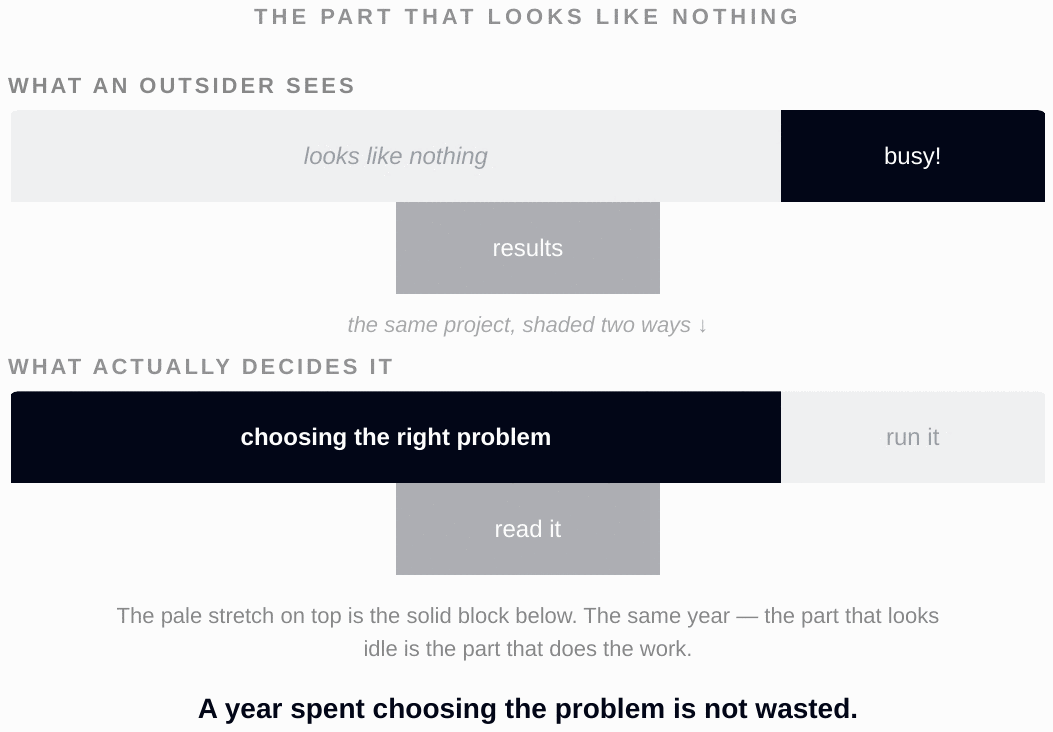
“If we can identify the right problem, eighty percent of your work is over.”
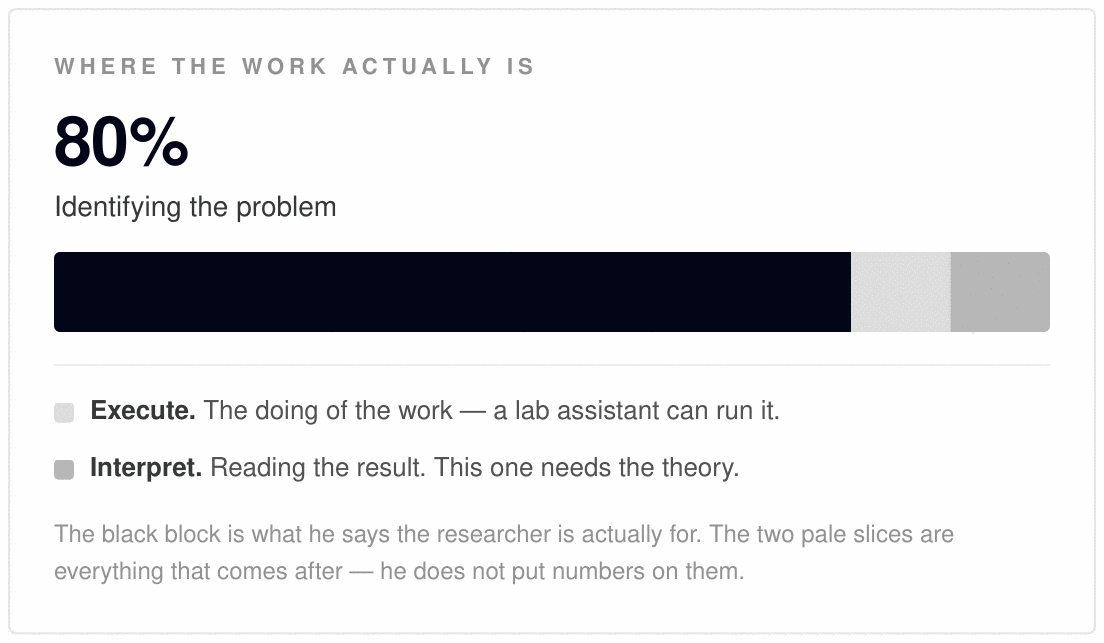
He goes further than that. A student who spends an entire year choosing the problem has, in his accounting, wasted nothing.
“If you spend one year to identify the problem, no problem. It is not a waste. That is the most important part.”
This is the rule he has lived by since the 1980s, when he left a Kerala village that had only recently received electricity and went looking for a subject that would hold his attention for the next forty years. He found it in polymer composites — the branch of material science currently rebuilding aircraft wings, satellite fairings, wind turbine blades and the interior panels of new cars.
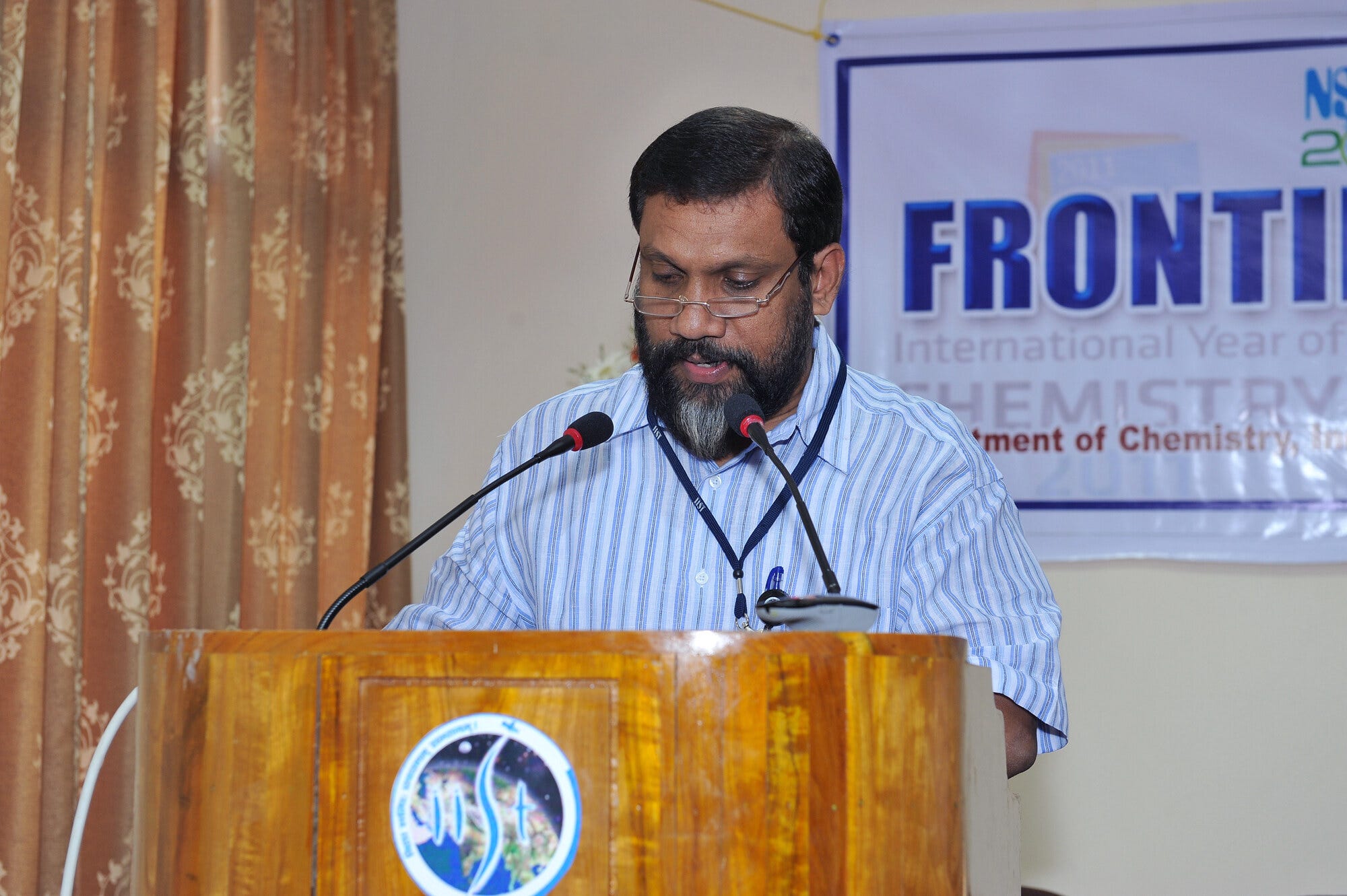
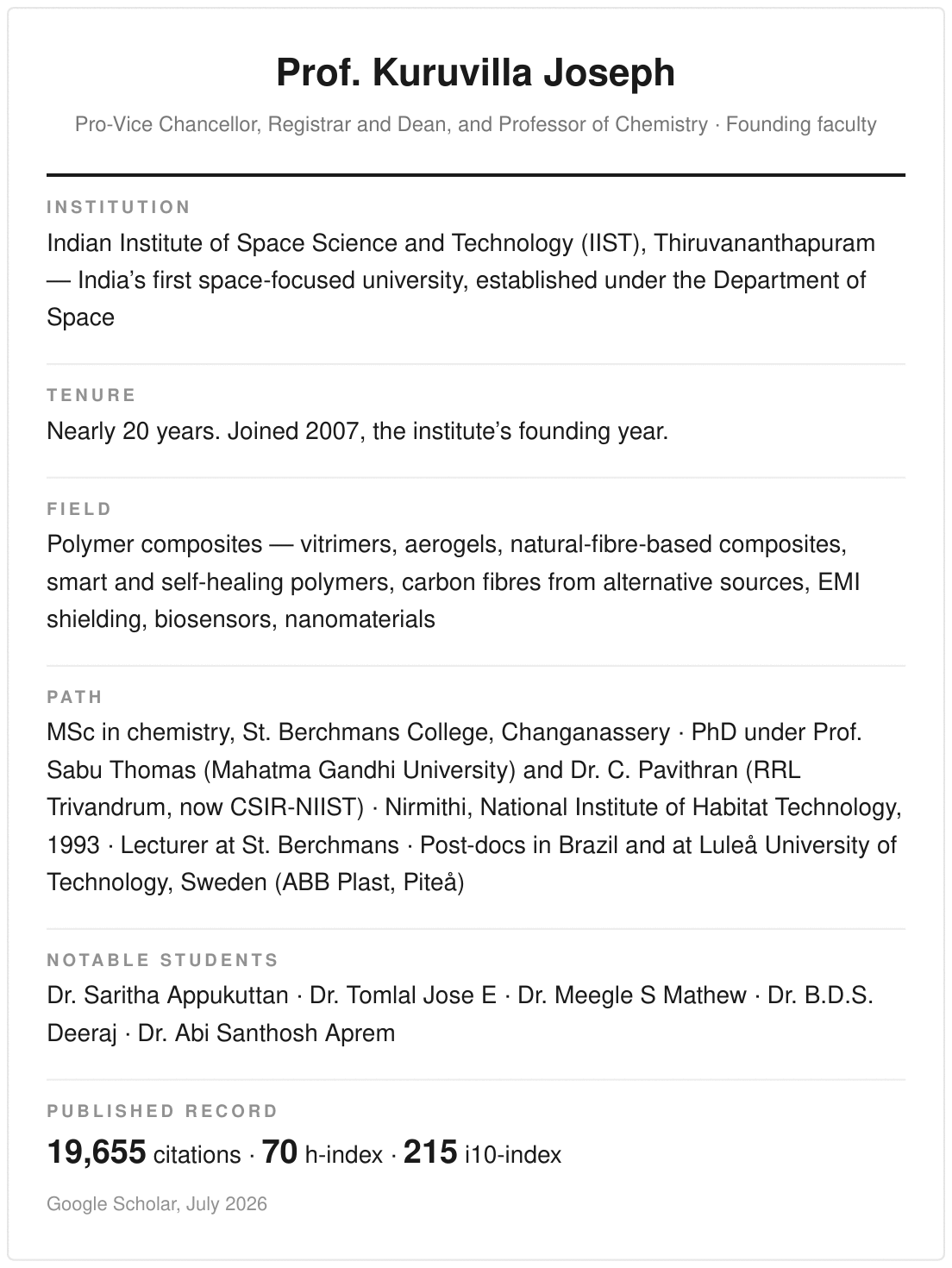
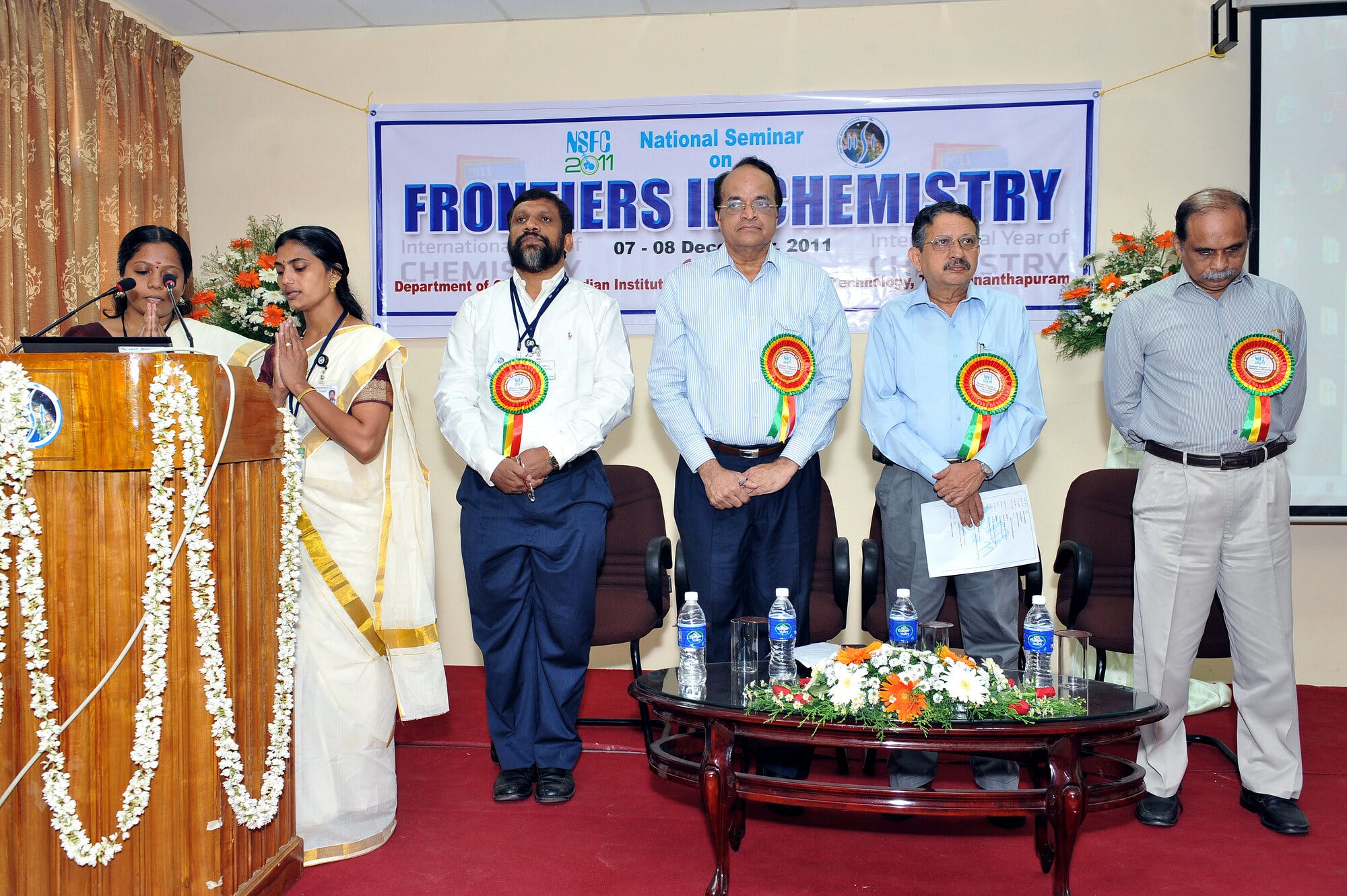
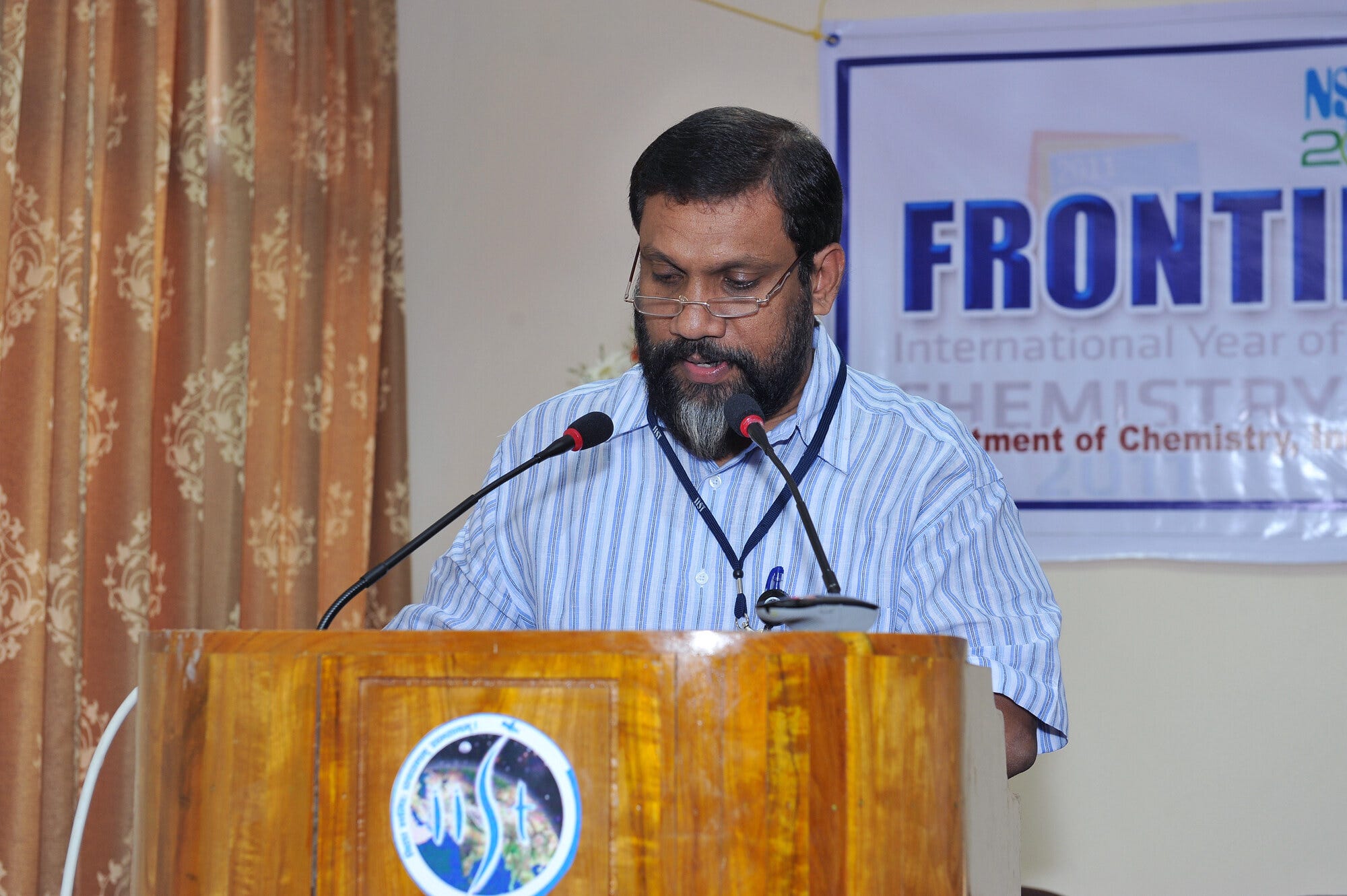
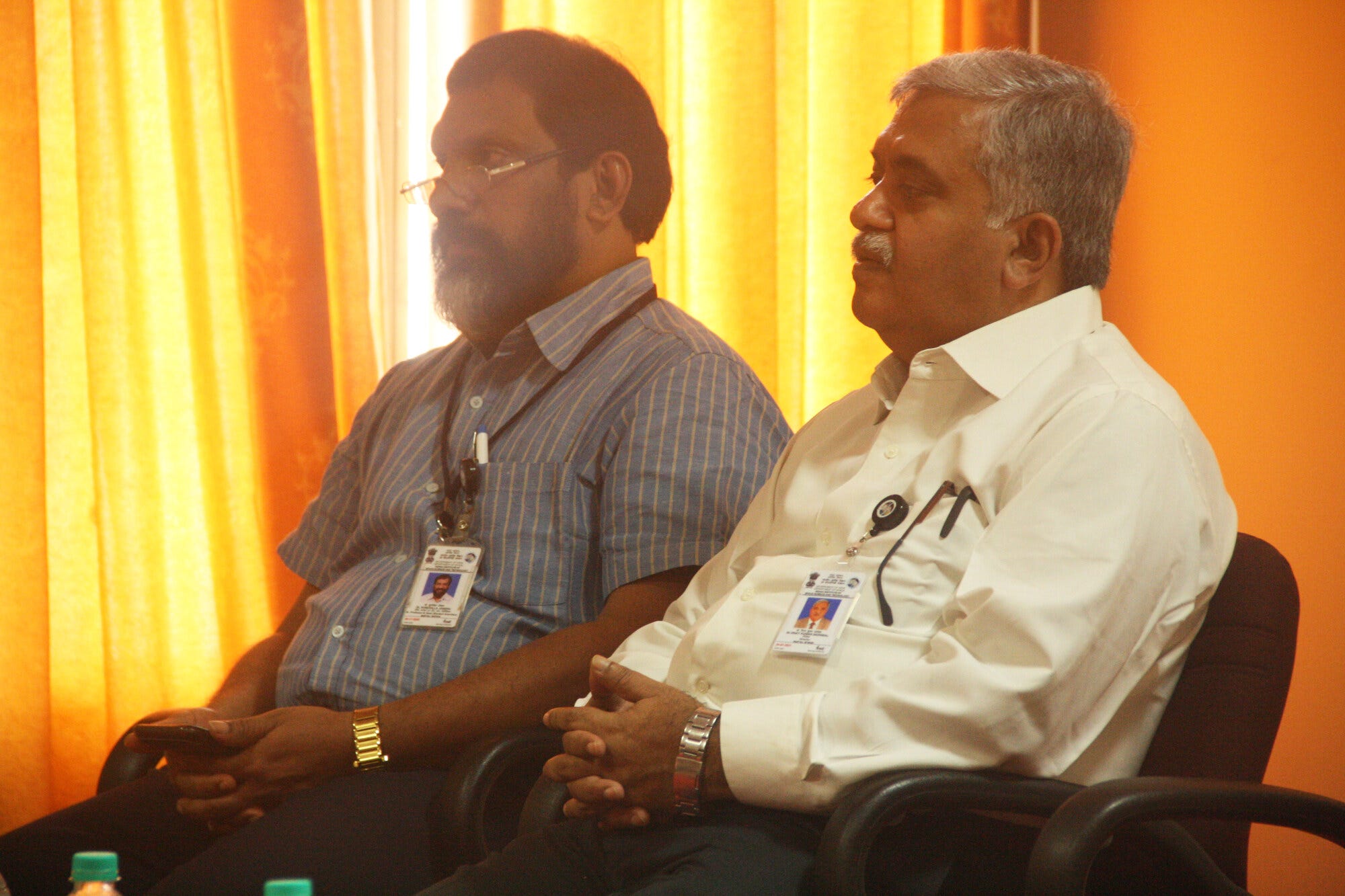
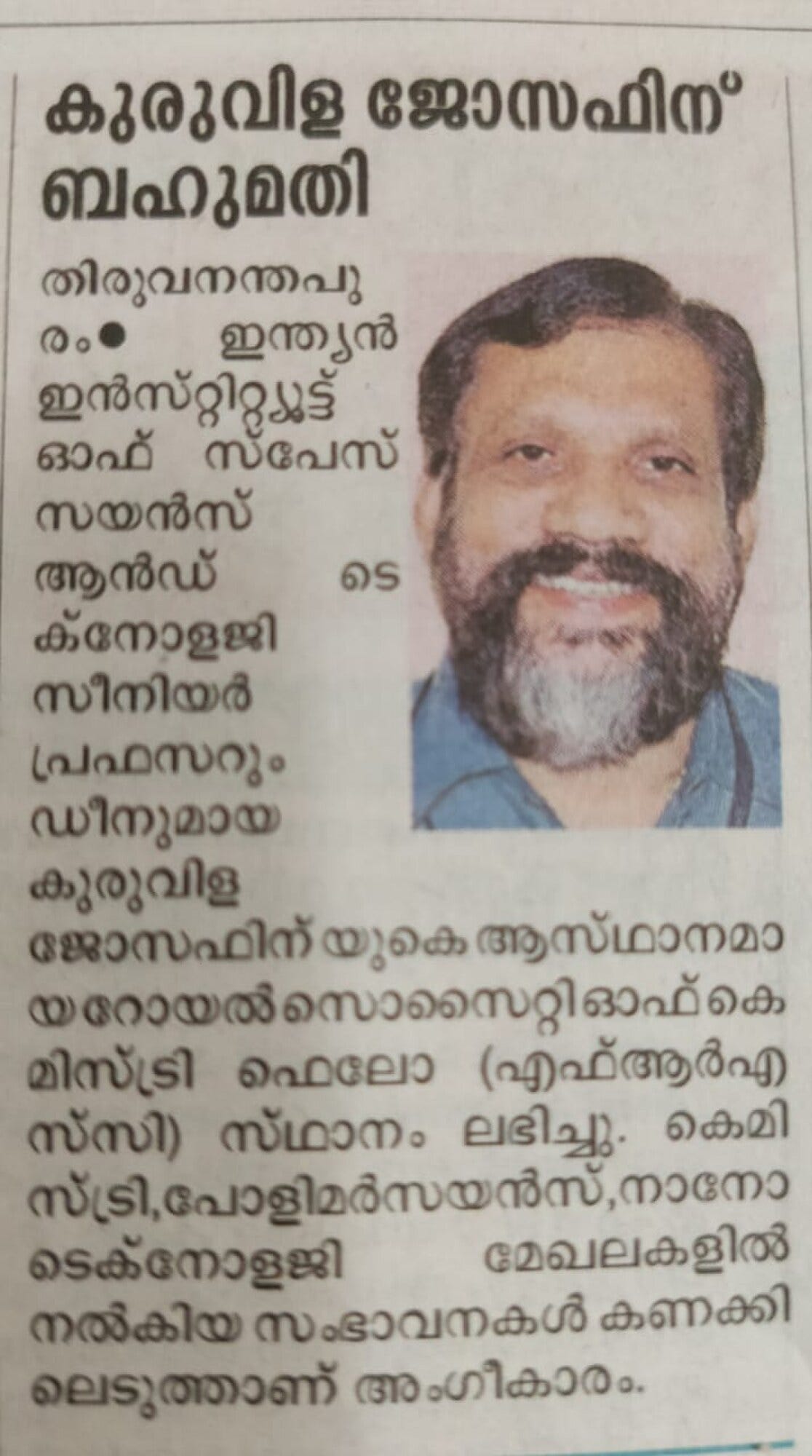
He found his way, eventually, to the Indian Institute of Space Science and Technology in Thiruvananthapuram, where he helped build the chemistry department from scratch. He has been there nearly twenty years. He now serves as the institute’s Pro-Vice Chancellor.
A box of facts
A village with no electricity
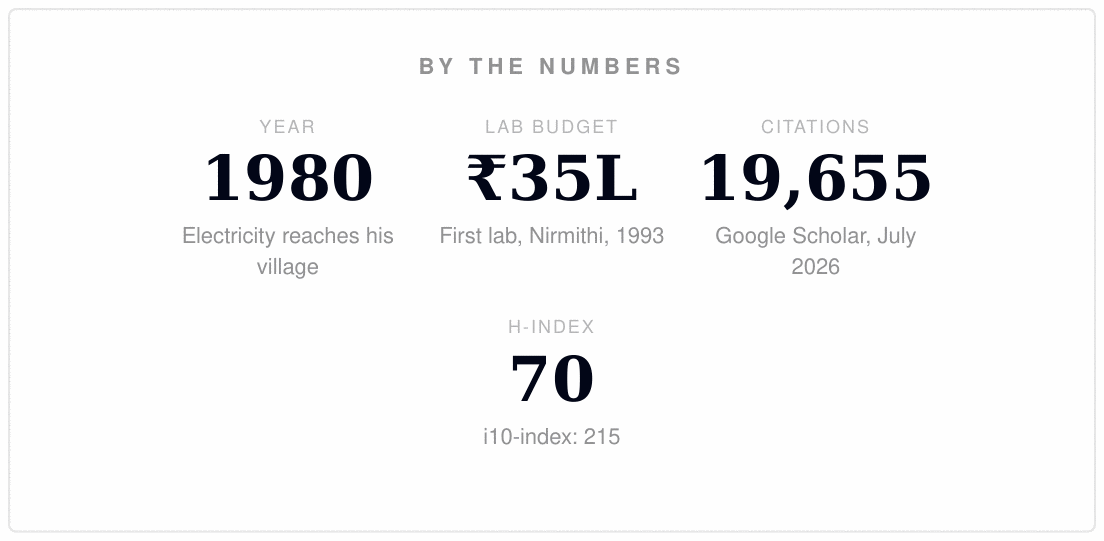
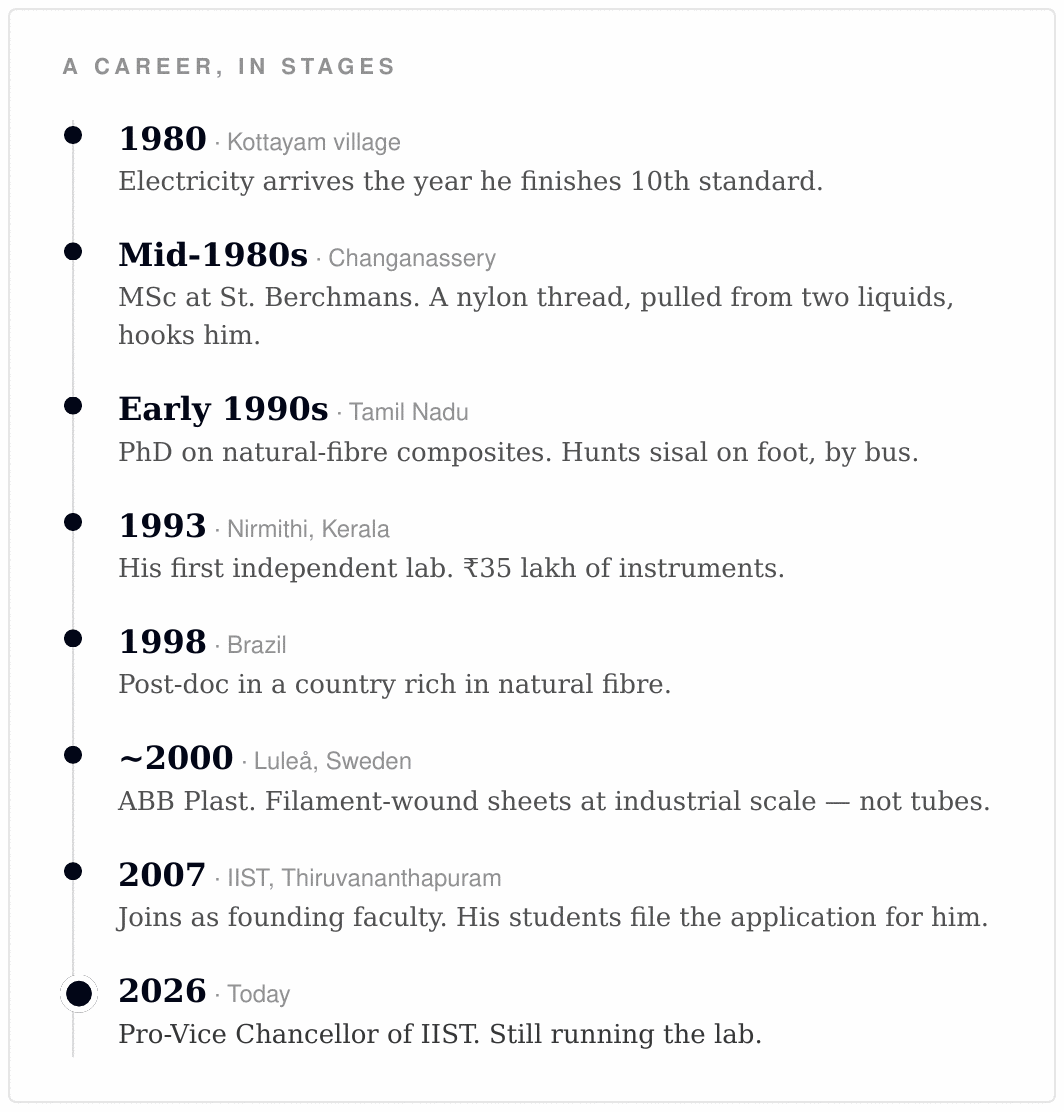
Kuruvilla Joseph was born in Kottayam, Kerala. He remembers the year electricity reached his house. It was 1980.
"In our house, electricity — we got it fully only in the 1980s, when I had completed my 10th standard. And that was not only me. That was the situation all over the state."
He was ten in 1975, fifteen in 1980. Everything before then happened by kerosene lamp.
His schooling began the way schooling had begun in that part of Kerala for generations. Before any formal school, a traditional teacher would sit with the child and teach them to form their first letters. It went on for about a year. At the end of that stage came a small ceremony, a convocation with its own Malayalam name. Today, he says, you would call it an initiation.
"Every family knew every other family. Not only nearby — I am saying within a radius of three, four, five kilometres. The village knew each other."
The roofs of most houses were thatched with coconut or palm leaf, and the thatch had to be replaced every year or two. That work, like almost everything else, was done collectively. If a family had a wedding, a large crowd assembled on its own — cooking, bundling, raising the shamiana. No one had to be invited. No one had a phone.
"If there was a death in a family, all would come. No telephone, nothing like that. No telegram — that was also very difficult. But they would volunteer. One would say — I will go to this place. Another would say — I will go to that place. And everybody knew that this relative was coming. That is the kind of association life."
He repeats the phrase several times during the conversation. Association life. The school worked the same way. It is the thing, he thinks, that Indian childhoods have since lost.
"Very close association life was there. That is what is missing now. People have become very, very within the family. I don't know that much affection is there. The relations between neighbours and siblings — those are really missing. And now unwanted competition is also there."
The village was poor; he treats that as plain fact. The loss he keeps returning to is the unwanted competition that came later — absent in the years when every roof needed the same shared labour.
He completed his plus two in 1982. Software, the default for a bright Indian student today, did not exist as a career. One of his brothers had just finished an MSc in chemistry and pointed him toward the same path, for the job opportunities.
"We were looking for some kind of job. So chemistry."
The thread that formed in midair
For his MSc he went to St. Berchmans College in Changanassery — a Kottayam-district institution he describes as one of the best chemistry colleges in South India, and one that recently celebrated its centenary. It is also where his working life would keep returning: he would later teach there, twice, between everything else.
During his first year of MSc, he had his first moment of real wonder in a lab.
"There was a National Industrial and Science Exhibition. One of my teachers asked me to put up a stall on polymers. We did a demonstration of interfacial polymerization. You take two chemicals that do not mix. There is a phase separation — you can see the interface between them. You put a glass rod at the interface, and as you pull it up, the two chemicals meet at the boundary and react. Whenever they come in contact at the interface, they form nylon."
He is describing the nylon rope trick. Two liquids that will not mix — one a diamine, the other a dicarboxylic acid — sit in the same beaker. A thin, continuous strand of nylon forms where they meet, and you can wind it out of the liquid like thread off a spool.
The polymer forms only where the two liquids touch. Pulling exposes fresh boundary, so the thread keeps forming for as long as you keep winding.
In a small college exhibition in the mid-1980s, watching a thread form in midair out of two liquids, Kuruvilla Joseph decided polymers were the field. Polymer science barely existed in India then. He has stayed in it for forty years.
Looking for Selvam
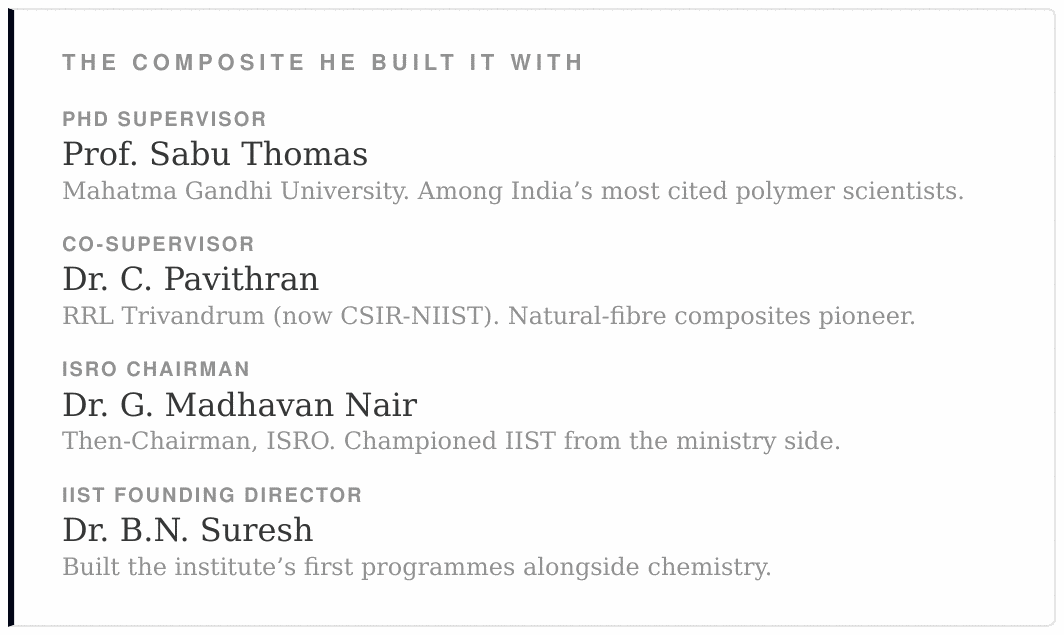
His PhD was jointly supervised by Prof. Sabu Thomas — then at the newly formed Mahatma Gandhi University, now one of India's most cited polymer scientists — and Dr. C. Pavithran at the Regional Research Laboratory in Thiruvananthapuram, later renamed CSIR-NIIST. The arrangement itself tells you something about the period. The university was so new that its facilities were minimal, so the two institutions struck up a joint programme, and Kuruvilla Joseph did most of his experimental work at RRL, which had the instruments.
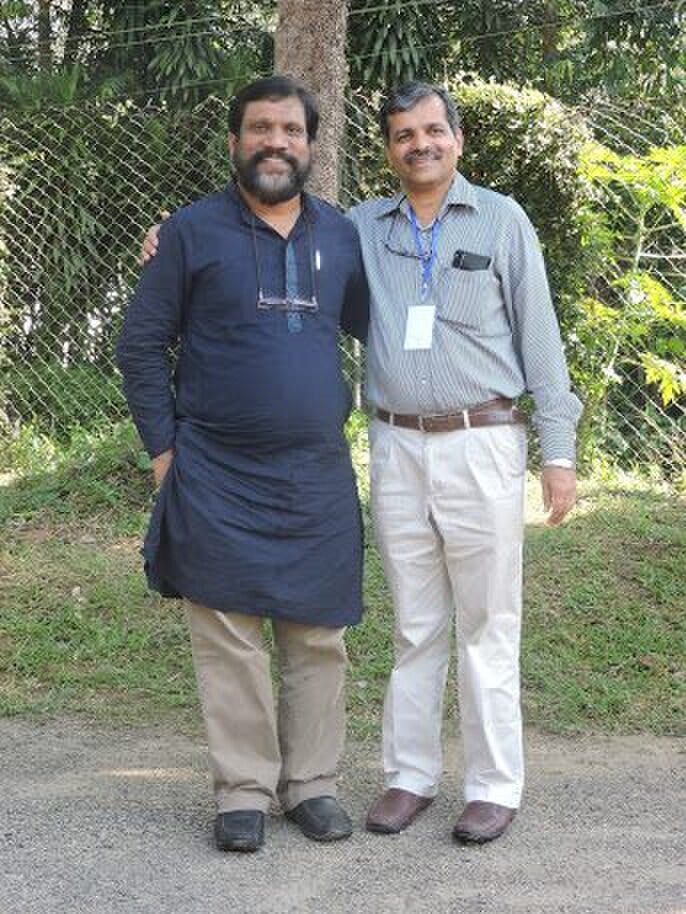
Dr. Pavithran's group worked on composites, and the young researcher started on natural fibres — sisal and jute. This was the early 1990s, and by his estimate ninety percent of the composite work in the country was being done with thermosets: epoxy, polyester, phenolic resins. He wanted to work on thermoplastic composites instead. The equipment for blending thermoplastics did not exist in the lab. There was no Brabender, no proper blending machine at all.
"You have only one hand-held extruder. You won't believe — I did this thermoplastic work on that."
"I was really curious. And in those days, the fellowships and all were very, very small."
Curiosity was the budget. And Kerala, it turned out, did not grow sisal commercially. Someone told him there was a man in Chozhangar, near Marthandam in Tamil Nadu, who produced it. The man's name was Selvam. Kuruvilla Joseph, with no phone number and no address, got on a bus and started asking.
"I finally somehow found his house. His wife said — he has gone to the mala, the mountain, to cut the leaves."
A boy from the village walked him up the mountain to the plantation. When he found Selvam, he was told the fibre had already been sold. If he wanted some, he should go on — there was another man selling it in a village near Tirunelveli, farther down the state.
He got on another bus.
"When I reached the village near Tirunelveli and took a photo, somebody knew this fellow. And when we went to the village and met the guy, they were very, very generous. Very poor people in a village. They gave me banana and water, and collected the fibre for me. When I saw the fibre, I was really excited. If I tell this today, you won't understand."
He laughs at the last line. A PhD student today would order the fibre online and have it delivered in two days. The hunt is part of why he knew the material — where it grew, who cut it, what it cost the people who lived off it.
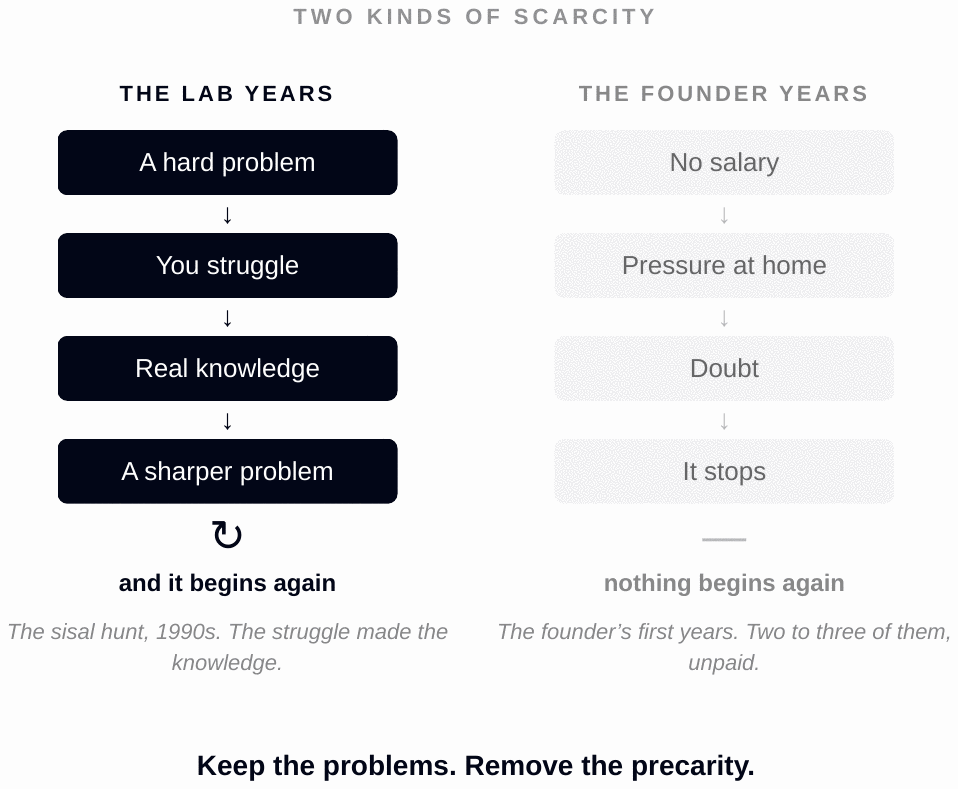
"Whatever suffering I went through in those days — that made my theoretical and practical knowledge very strong. When I was trying to do things myself, lots of problems would happen. I was trying to solve those problems, discussing with others. That is what made it strong."
The habit stayed with him. Decades later, when he advises PhD students, he tells them the same thing: the difficulty is the teacher. Identifying a problem is most of the work; running the experiments is technique.
The company he almost started
During the same period came the regret he still carries.
He had developed a thermoplastic composite with properties good enough that a visiting team from industry came to see it. Two of them, in the middle of the visit, stood up and asked him directly whether he was ready to transfer the technology.
He was a research student. He was not ready for anything of the kind.
"I missed that. I really missed. In fact, by that time I had even registered a company. Even today I have that letter in the drawer."
The technology eventually reached the market — but not through him. The commercial version of that composite, he says, is now sold widely. He had the science and the paperwork and nothing else: no co-founders, no industrial partners, no idea how to price, sell, or scale. The incorporation certificate sits in a drawer as proof that the idea was his first.
It is a story that surfaces often in Indian research — a scientist with a working prototype and no ecosystem to launch it into. He does not linger on it, but he returns to the lesson several times in the conversation. Research institutes and industry have to be built next to each other, not at different ends of a city.
Thirty-five lakhs, 1993
After his PhD, he went looking for a job. He found an unusual one.
Nirmithi — the National Institute of Habitat Technology — had just been set up in Kerala, focused on low-cost materials for construction. In 1993 he joined the effort to build its laboratory from nothing. The work began, characteristically, with a problem-finding exercise: a brainstorming session with experts from the IITs and from industry on which conventional building materials could be replaced, and with what.
"We had a very good meeting, and based on that I set up a laboratory. I still remember — in 1993, 35 lakhs of instruments, if I'm correct. Thirty-five was a good amount then."
(Editor: At the rupee's purchasing power that year, comparable to roughly Rs 1.5–2 crore today.)
He started work on fly ash composites, natural fibre composites, alternative building materials. But the institute was new, his position was not permanent, and a tenured lectureship opened up at St. Berchmans — the college where he had done his MSc. He took it.
"The management was very, very helpful. They supported me. I created a lot of research facilities there. I got extramural projects. Many research students. Internship students. I was enjoying the life."
I was enjoying the life. He says that sentence more than once in the interview, each time about the period just before a move. In his career, contentment has been the signal that a change is coming.
Filament sheets in Luleå
In 1998, the first change came: a post-doctoral position in Brazil.
"The Brazilians were really interested in my work. Because Brazil is a country with huge natural resources. A lot of natural fibres. Very good in composites. In many places, many industries. I had a lot of interesting collaboration. That also made me very strong in theory and practice — in composites in general."
He worked in Brazil, came back to the college, then around 2000 took a second post-doc in Sweden — at Luleå University of Technology, working closely with ABB Plast in Piteå, up near the Gulf of Bothnia. ABB Plast was a manufacturer, exporting composite products across Europe — among them refrigerated shipping containers, built by resin transfer moulding.
"We were real manufacturers of composites, exporting the product. We could go and see the process. We could take a sample, test it. The exposure was excellent."
What struck him hardest was the scale of one particular technique.
"Filament winding — most of us, when we hear it, will think of a cylindrical tubular structure. No. They were making big filament-wound sheets. Huge sheets. Huge industrial composite structures, totally insulated. And they could machine them. In those days, they were exporting all of it."
He took photographs of the machines. He keeps them still, and offers to show them to any visitor to the institute.
There was a second lesson from that stretch of Europe. By the late 1990s, European and Japanese car interiors — door panels, parcel shelves, boot liners — were routinely made of natural fibre composites: hemp, flax, kenaf or jute bonded into a polymer matrix. The fibres he had hunted across Tamil Nadu by bus were, in other economies, an industrial input with a supply chain.
"If you take any automobile, the inner parts are made of natural fibre composite. Household appliances and everything. A huge industry is looking for natural-fibre-based composites. That is what is happening in other countries."
He returned to the same college in Kottayam, but with a working picture of how a composites industry actually runs at scale — the processes, the equipment, the integration between research and manufacturing. It became the reference point he carried for the rest of his career.
"The research talent in India is very good. We have brilliant students. But the outlook is the problem."
The signature
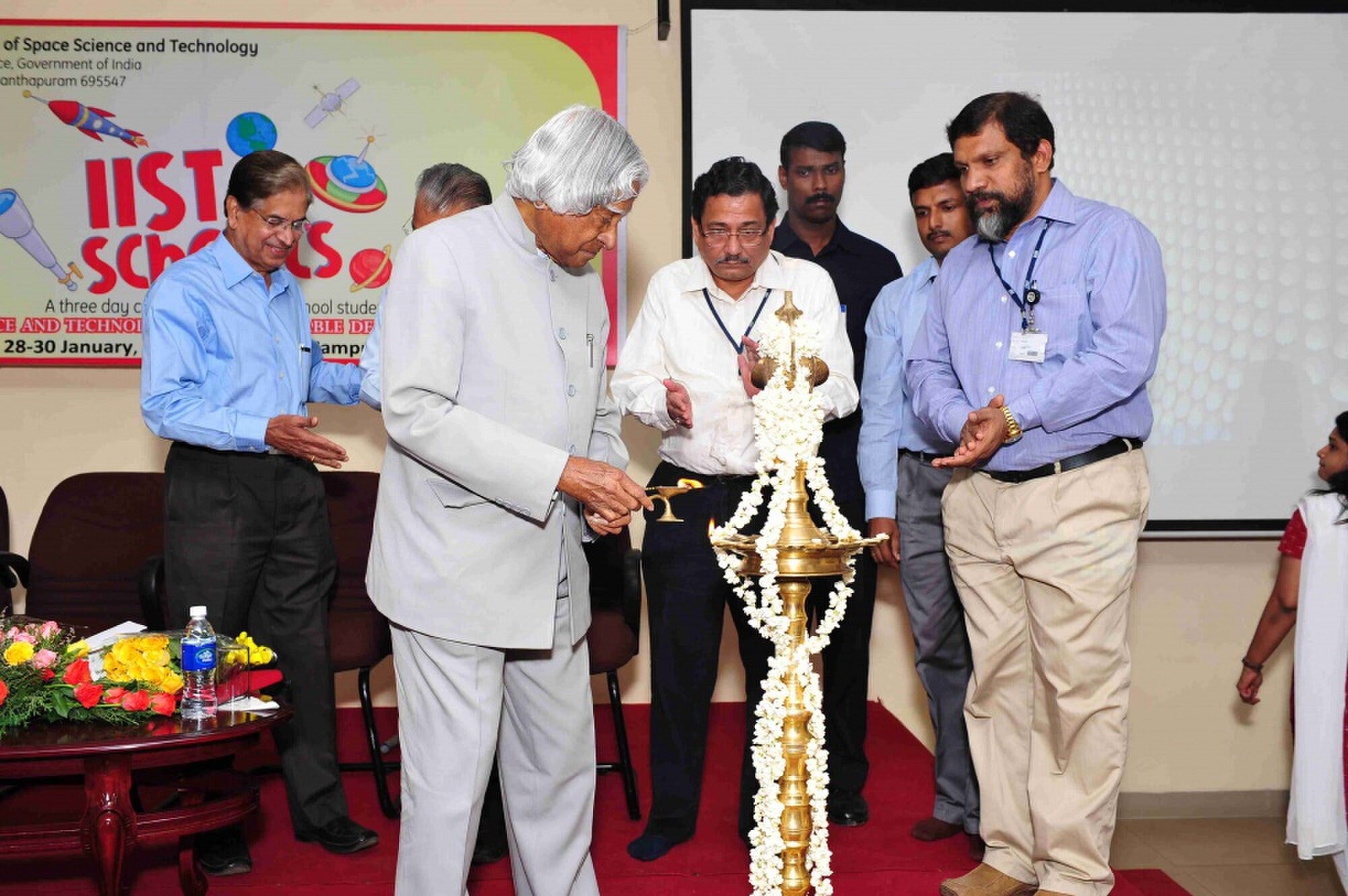
IIST was announced in 2007 as India's first university dedicated to space science and technology — an initiative of the Department of Space under then-Chairman Dr. G. Madhavan Nair. Dr. A.P.J. Abdul Kalam was named its Chancellor. Its first director was Dr. B.N. Suresh.
Kuruvilla Joseph, by then, had a good life exactly where he was.
"In those days, I had many PhD students and internship students. It was close to my house also. Many students, school students, were coming there, doing internships. I was enjoying the life. Then this advertisement of IIST appeared."
He inquired. His senior colleagues talked him out of it.
"They said — no, no, they are looking for people from outside India. This is a very prestigious institute. Kalam is going to be the Chancellor. So I lost my hope. I didn't apply."
His own PhD students did not accept that. They filled in the application on his behalf and brought it to him on the last day.
"They said — either you apply, or we will apply for you. Let us try. At the last minute, I signed and sent the application."
Then a call came: a screening interview in Bangalore. He told his family he was not going — he was happy where he was, so why should he? His family overruled him.
IIST offered him a flight ticket; he left it unbooked until it was too late to matter, and the day before the interview he took a bus from Kottayam to Bangalore instead.
"I was very cool. I am not going to get it."
Only later did he learn there had been more than a hundred applicants for the position.
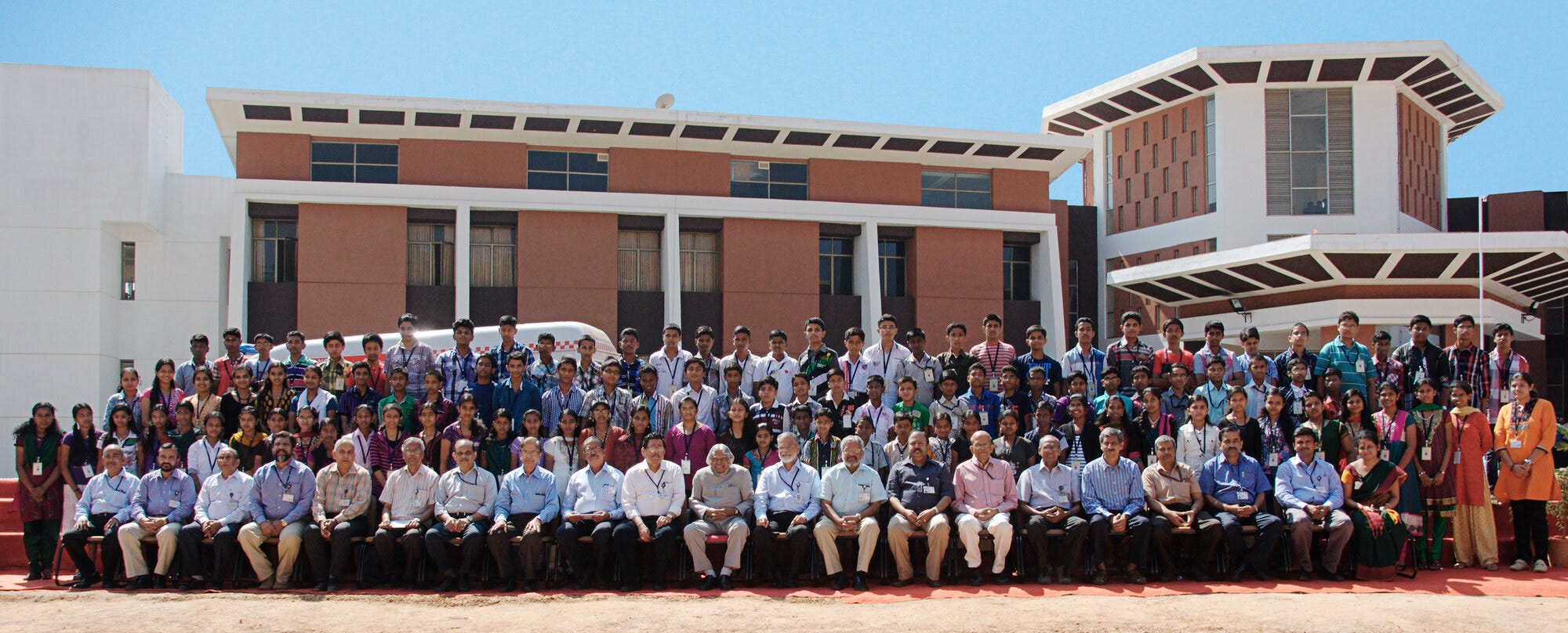
He got the job.
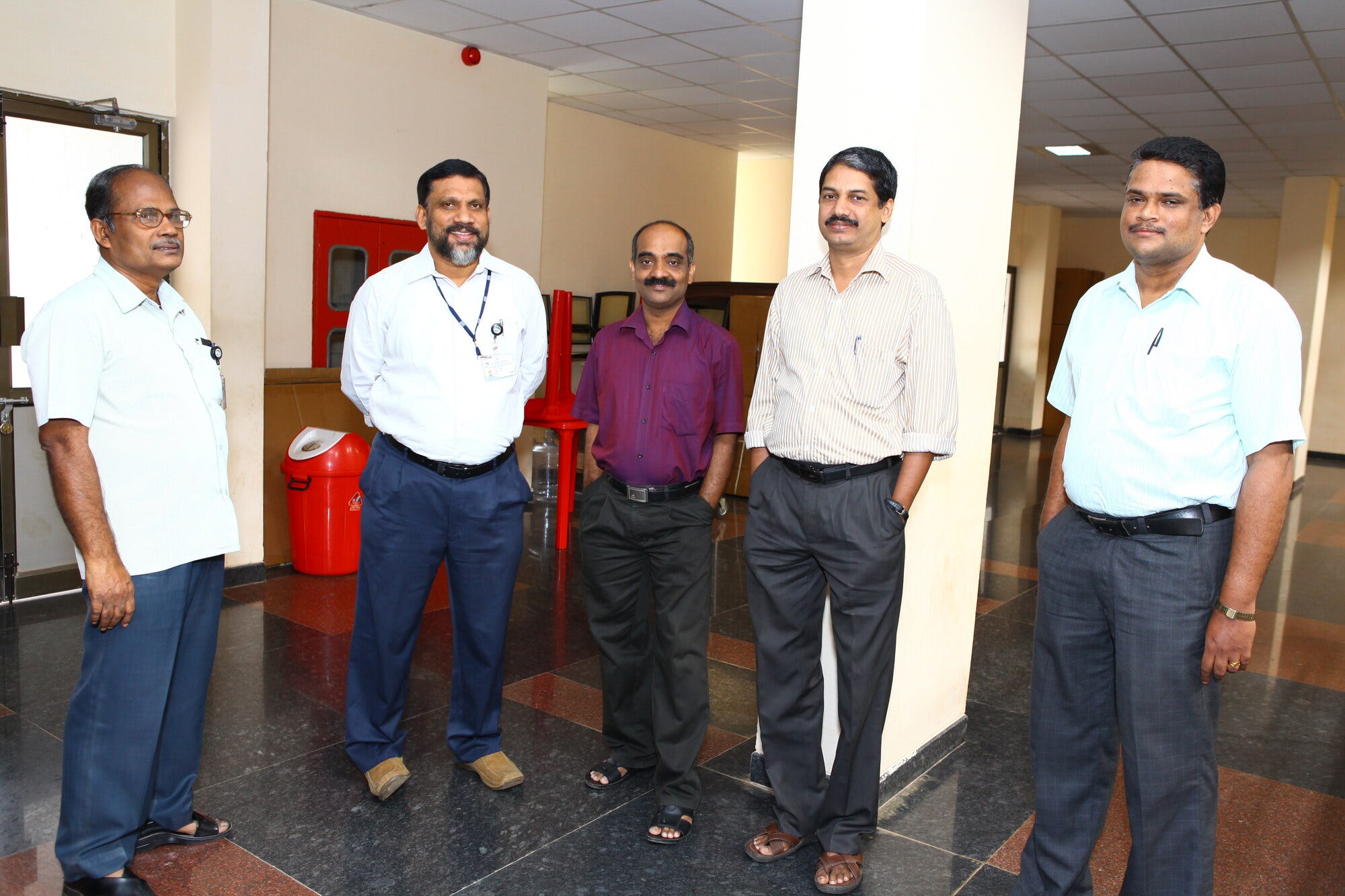
IIST began operations from a temporary facility. In August 2010, it moved to its permanent campus at Valiamala, outside Thiruvananthapuram — and by the time the institute moved, the proposals he had written and the instruments he had procured were waiting.
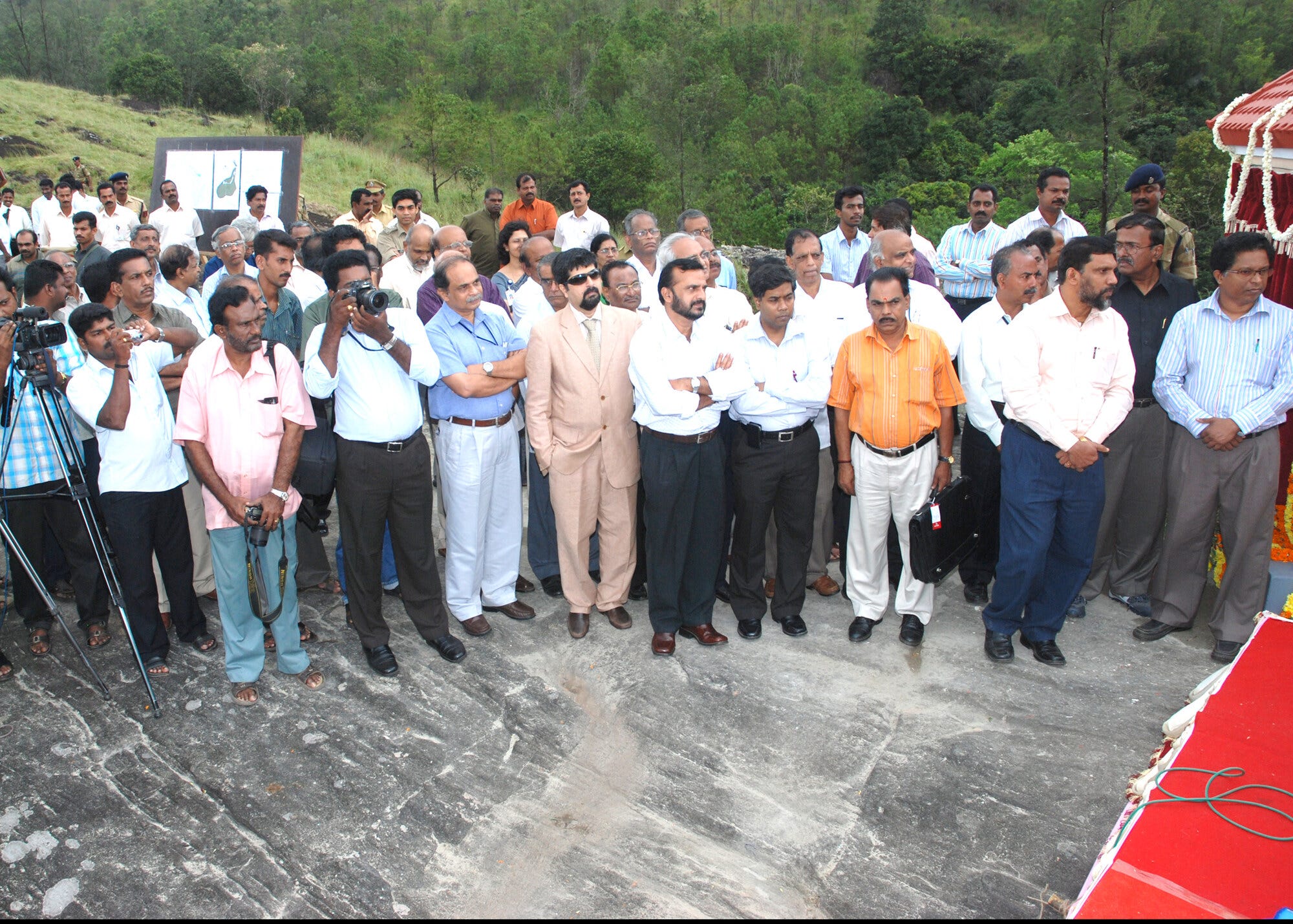
"In 2010, when we moved to this campus, everything was in place."
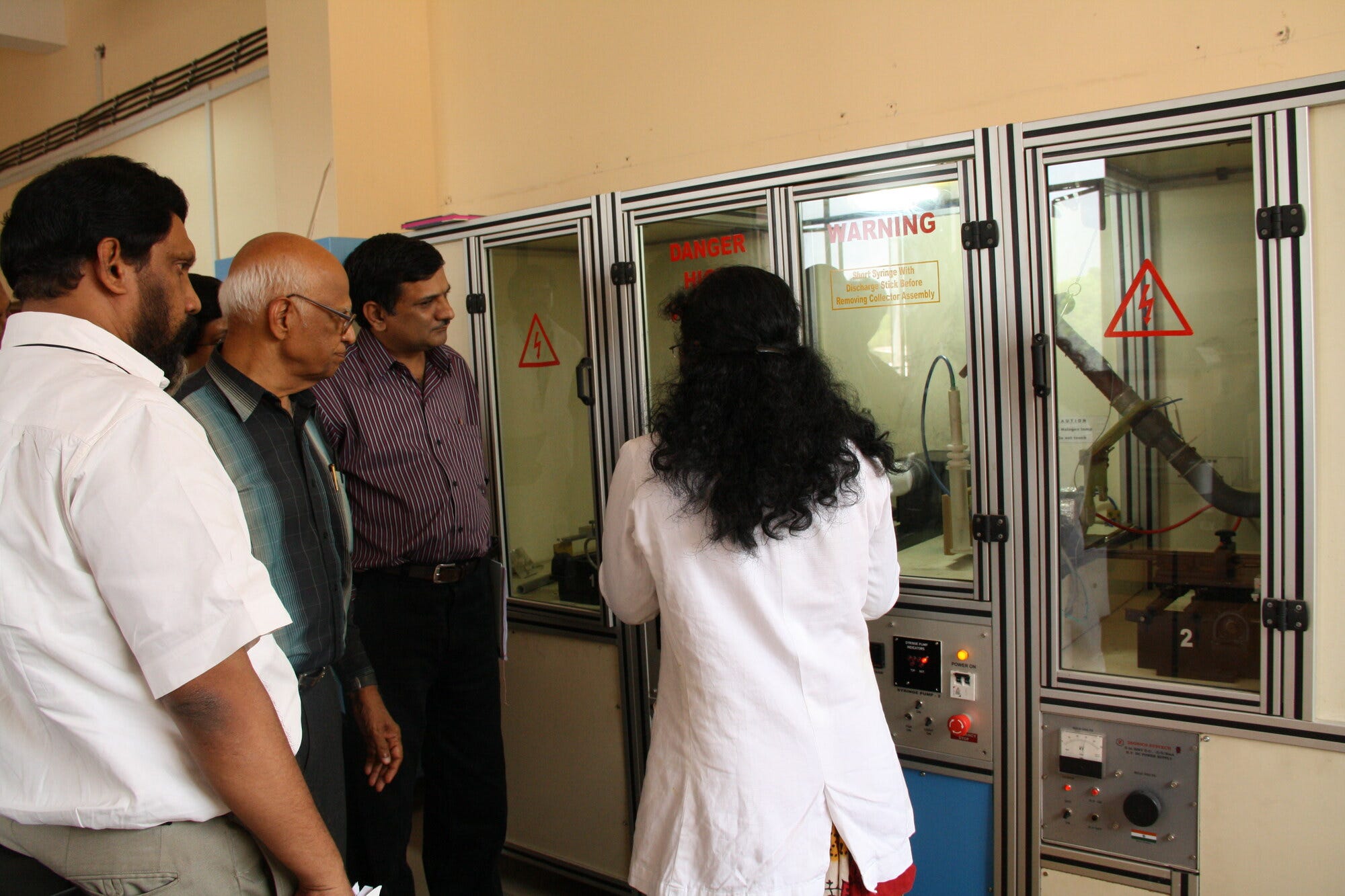
He calls that day one of the proudest of his career.
"2010, August 15."
He remembers the date.
Kalam's follow-ups
A personal note. Like many Indians of my generation, I found Dr. Kalam before I found science — I bought Wings of Fire as a boy and it rearranged something: it said it does not matter where you start. I have asked everyone I have met who worked with him what he was actually like, and I have never once heard a different account. Kuruvilla Joseph's is no exception, but his is more specific than most.
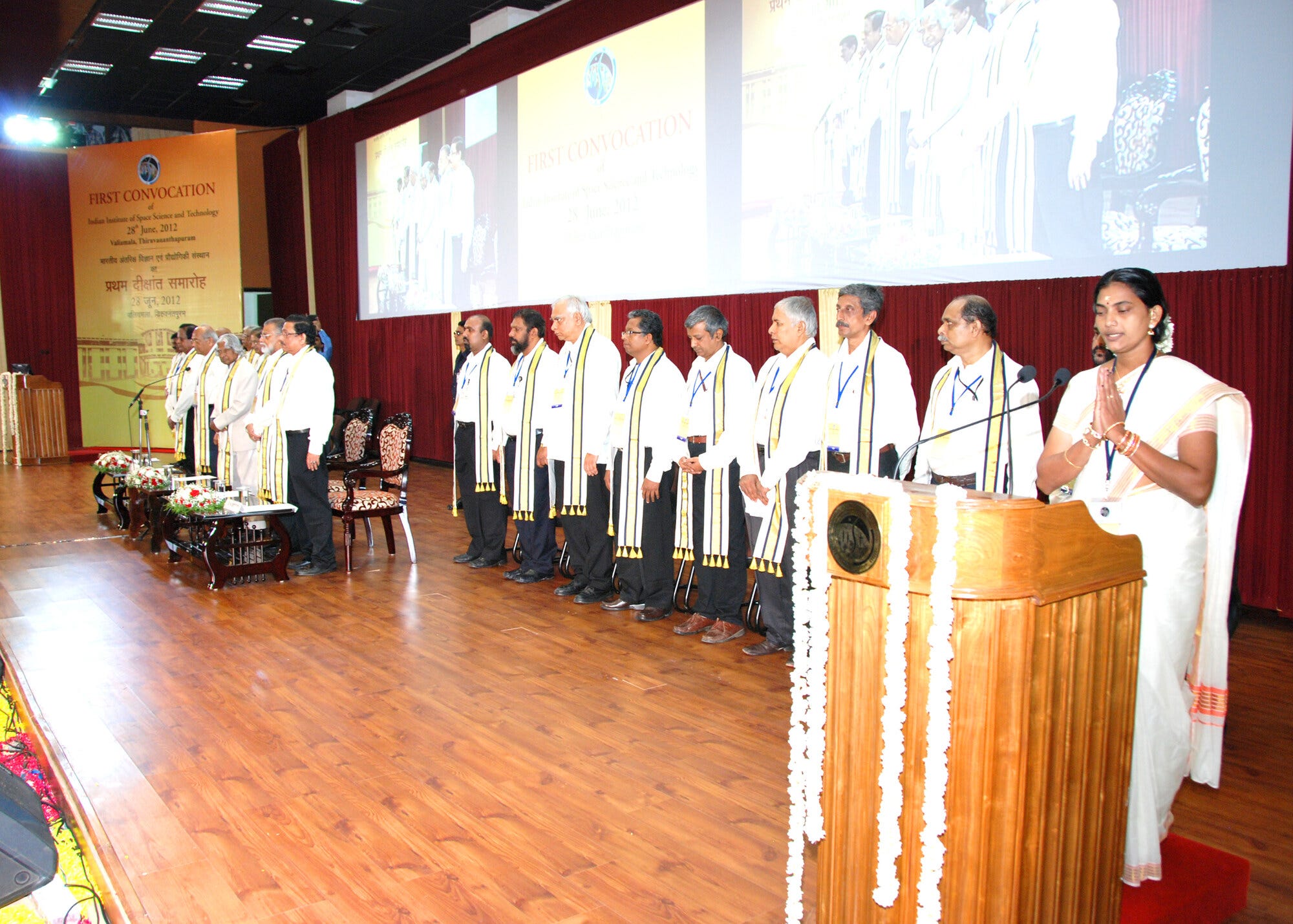
Kalam attended the governing body meetings at IIST. He visited the campus repeatedly in the years after the move to Valiamala. He gave lectures. And he assigned work.
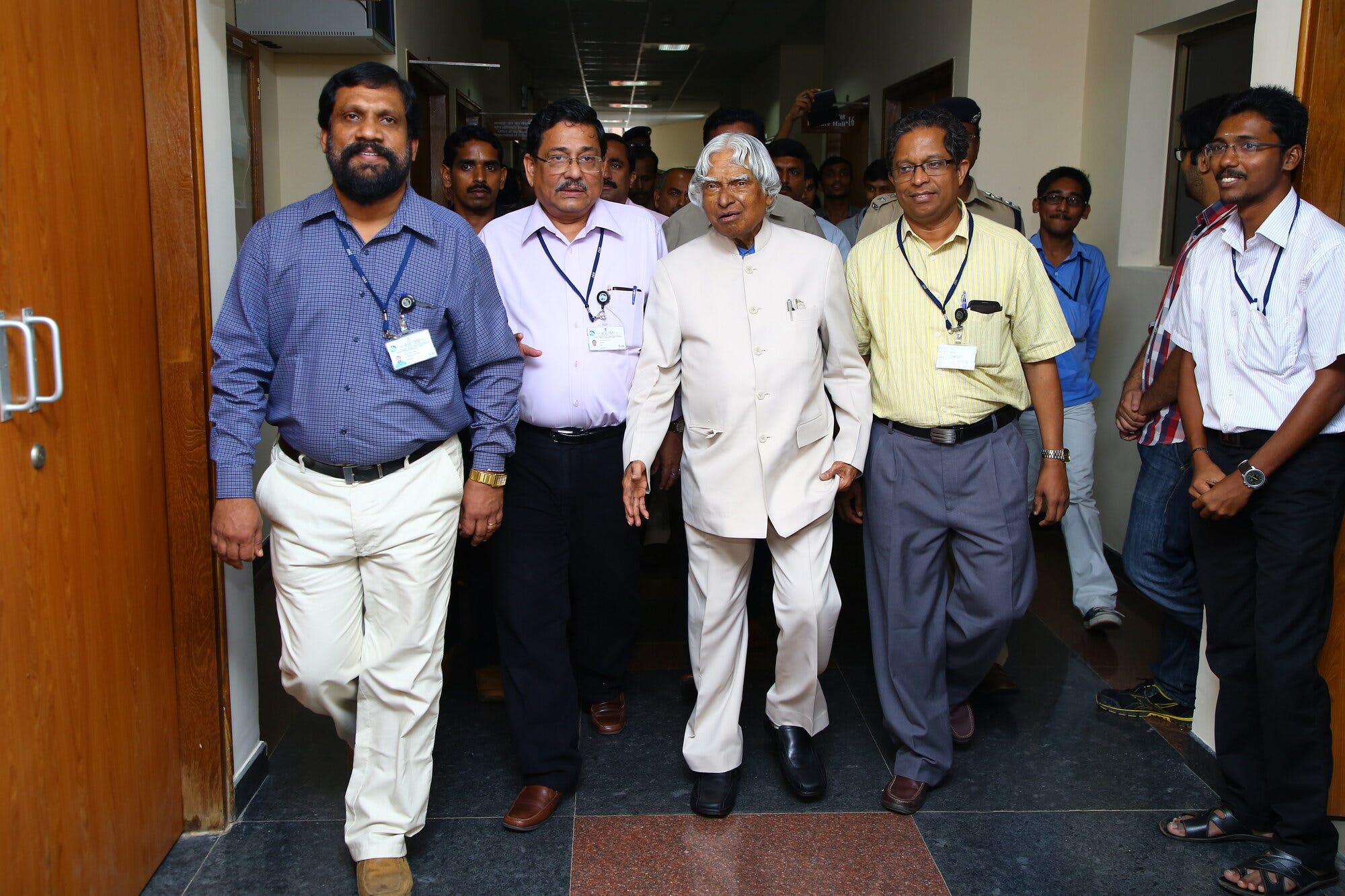
"He was supporting everyone, and he was monitoring. Not only that — he would not simply say something and go. Next time, he will ask: what happened to that? Whether you did it, whether you did not."
Most people at that level say things and move on; no one expects them to remember. Kalam remembered. The people around him learned, quickly, not to propose anything they were not prepared to deliver.
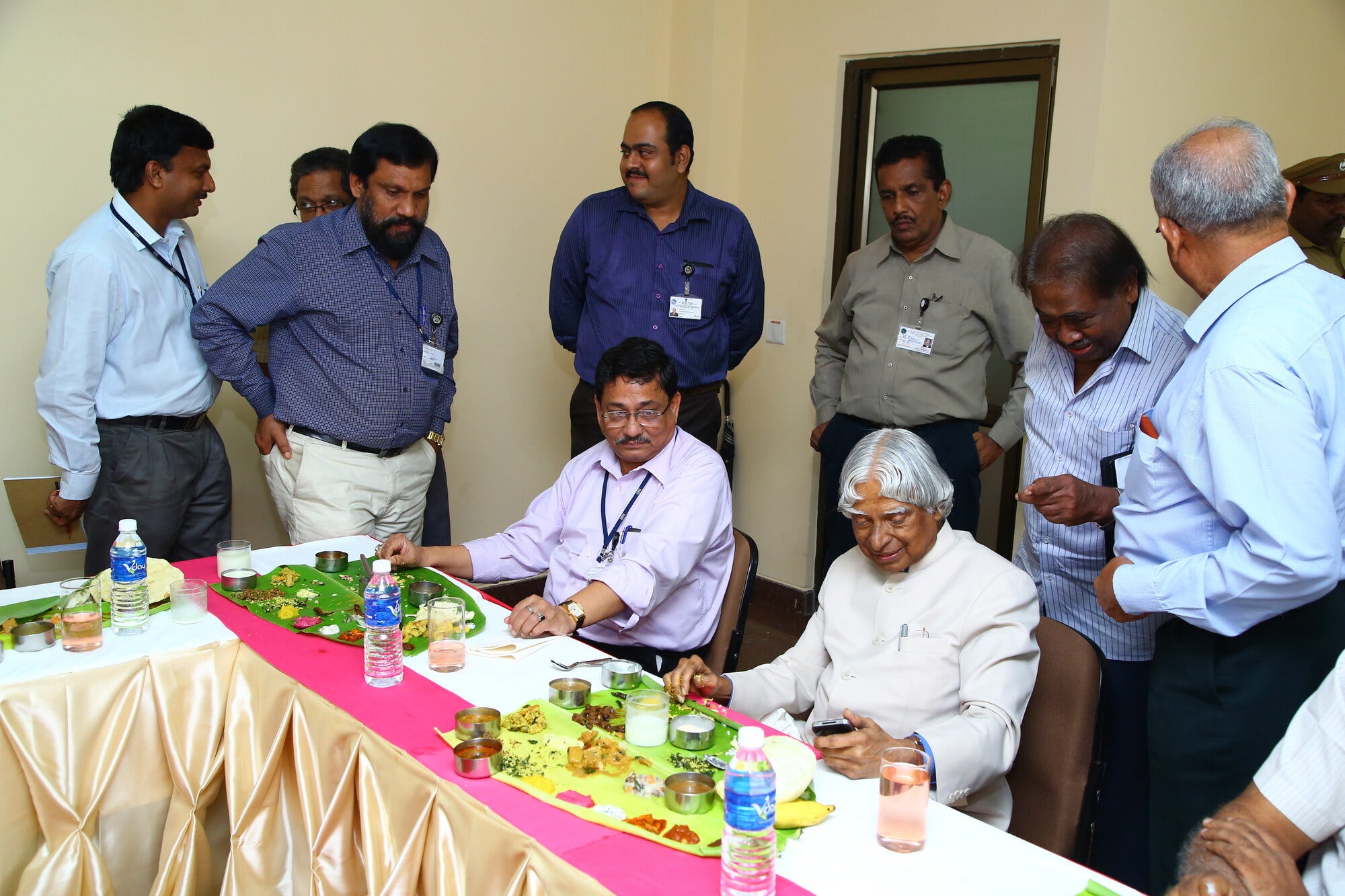
One of his standing instructions, as Kuruvilla Joseph recalls it, was that the institute should build Centres of Excellence wherever its faculty already had real strength. From the chemistry side, Kuruvilla Joseph presented the case for a Centre for Nano Science and Technology — not just the theory, but what the laboratory itself would look like. Kalam heard it, backed it, and asked about it again on his next visit.
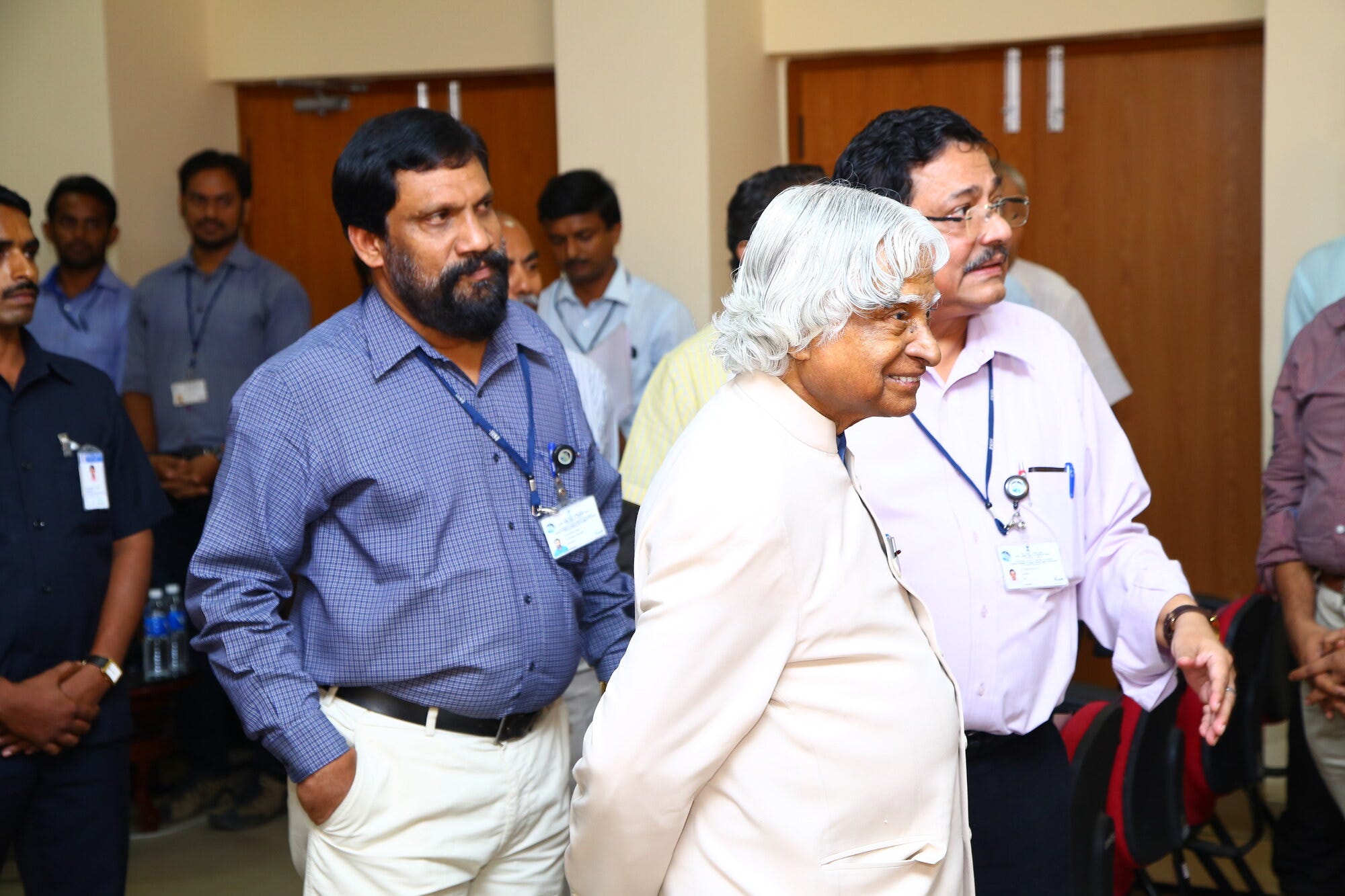
Asked how he built the chemistry department, Kuruvilla Joseph will not talk about himself in the first person. He credits two people first — G. Madhavan Nair, then Chairman of ISRO, and B.N. Suresh, the founding director — and reaches for a metaphor from his own field.
"In composites, we used to say: one plus one is more than two. But in a composite of fibre and matrix, you get a synergetic property."
The strength of the pair exceeded the sum of the parts. I extended the metaphor: one plus one equals eleven. He laughed, and accepted it.
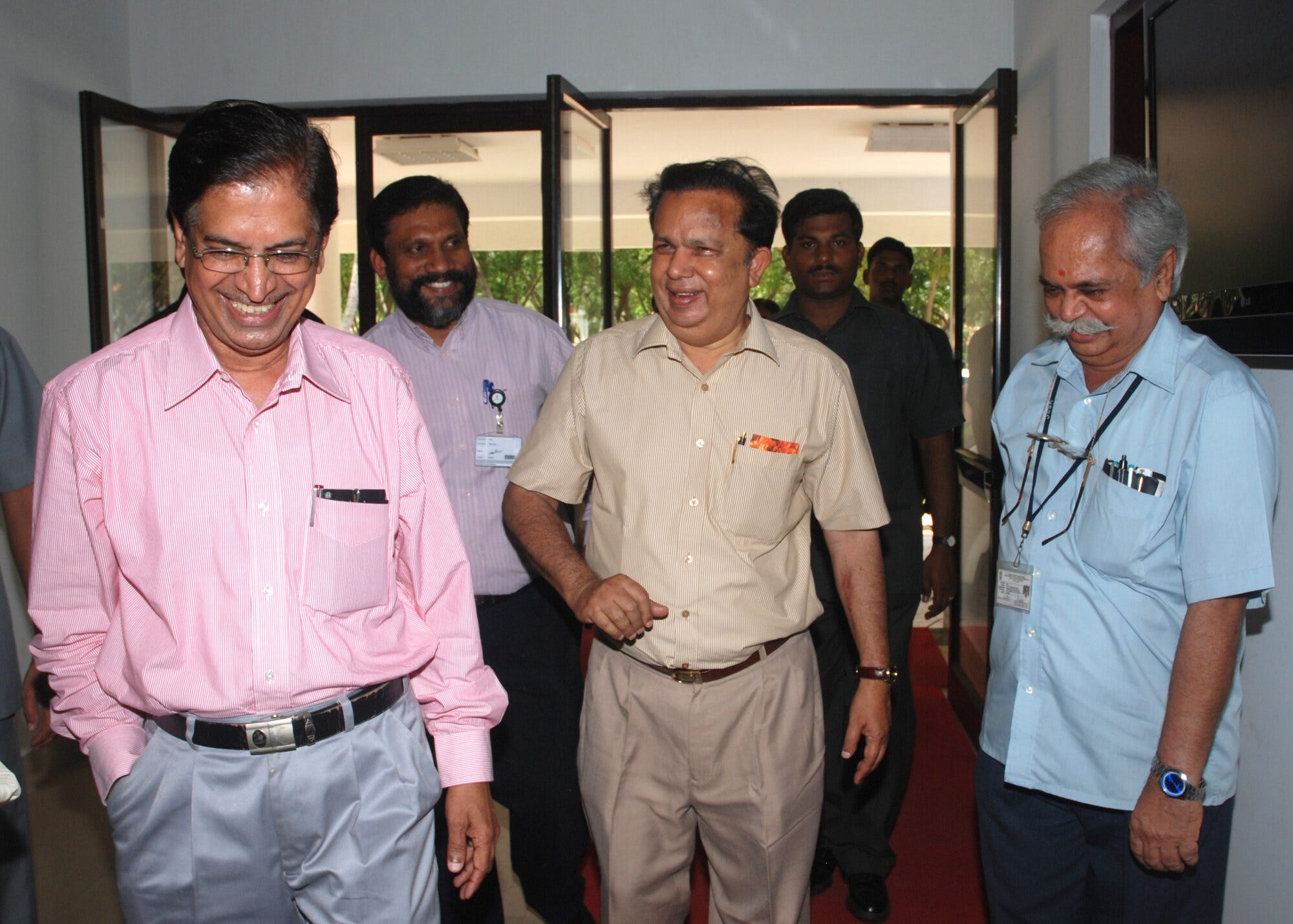
The first five years at IIST were spent writing proposals, procuring instruments, hiring, and running the chemistry courses. The institute was small. He had enough freedom to build the research infrastructure the way he wanted it — and a Chancellor who would check.
The three drivers
He has been inside Indian research for forty years, and he has a short, direct diagnosis of what is wrong with it.
"Look at what Indian research is for. A PhD is for three or four Ps. One — I am doing research, publishing a paper, that is very important. The second P — for getting a position. For a college lectureship or an assistant professorship, a PhD is a must. Another P — for promotion. So this is a position-oriented, promotion-oriented, paper-oriented research culture. That is killing it."
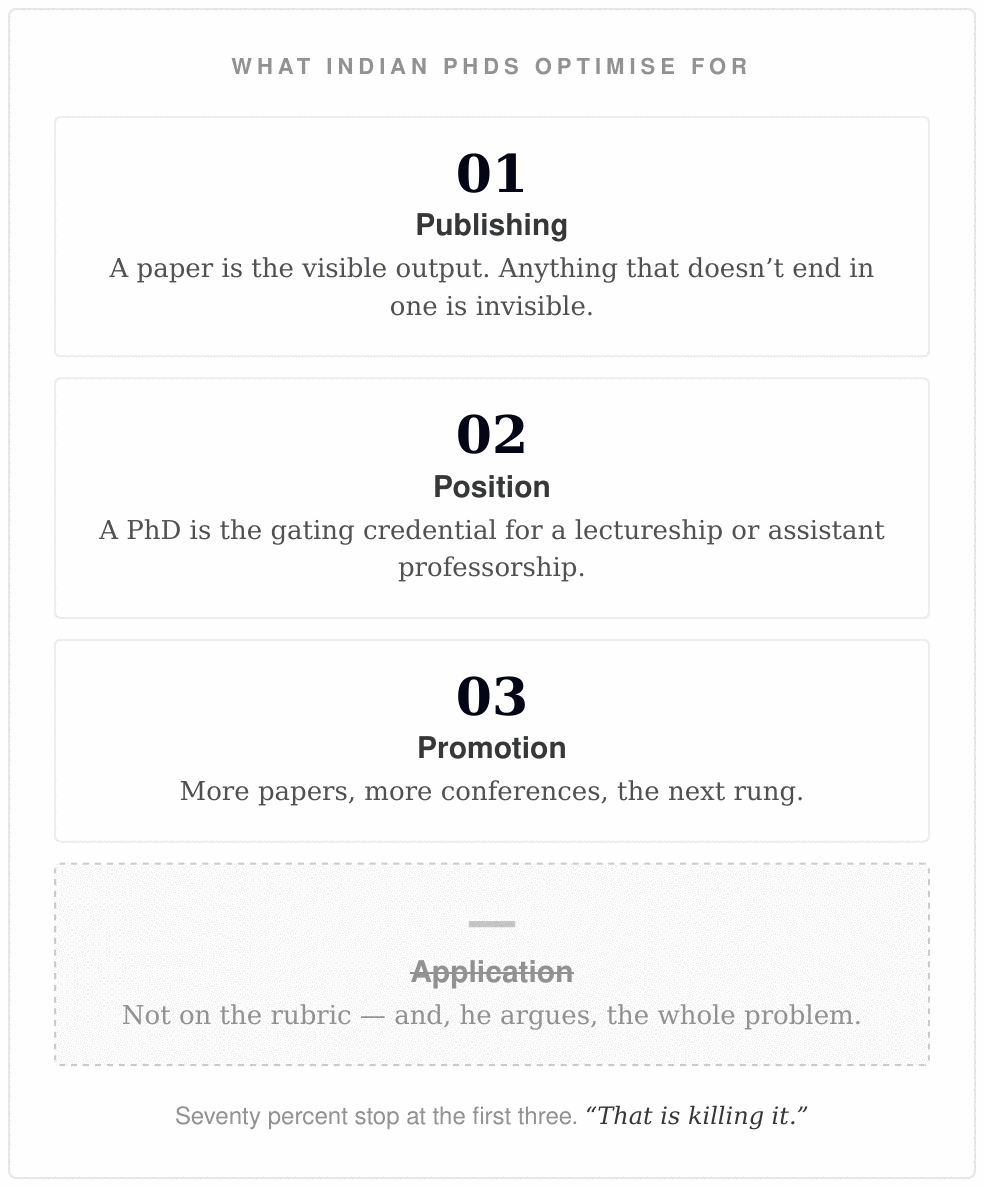
The problem, he says, is that most students never ask what the research is actually for. The guide hands them a problem. They solve it. They publish. They graduate. They never visit a factory. They never meet a customer.
"Seventy percent of people just want to get a PhD with some publications. They are not thinking about application. Recently that is changing. But still — seventy percent."
The remainder — twenty, maybe thirty percent, by his reckoning — are in it for the thing itself. His prescription for the rest is blunt.
"Actually speaking, applied research should be linked to the industry."
His entire method as a supervisor is built around that linkage, and it begins with the refusal that opens this article: he will not hand out problems.
"I tell them — these are the areas. Go through the literature. Because if the guide gives the problem, that's not correct. The passion has to originate from the student's own mind."
And the students need to see industry early. Not at the end of the PhD, when they are looking for jobs. At the beginning — before the problem is even chosen, because the problem should come out of that contact.
"When a student is joining with a guide, it is only guide and student and institute. Maybe he or she is going for some conference — that is all, over and done. They are not getting any industrial exposure. This exposure should happen at the beginning of the research. Not at the end."
"Fixing the problem is most important. If we can identify the right problem, eighty percent of your work is over."
Most research manuals treat problem identification as a preliminary step before the real work begins. He treats it as the work — and he splits what remains into exactly two parts.
"That is the most important part. The second part is the doing of the work — anybody can do that. If I have a lab assistant, I can ask him to make a composite, and he will do it. And then there is the interpretation of the results, where we need a very good theoretical background."
Choosing the question, and reading the answer. Everything in between, in his division of labour, is technique.
His second fix is physical: bring industry onto the campus.
"The industry should come to the campus. There should be an industrial park. Industry should totally associate with the institution. They should know, and they should guide. When you are doing research as a PhD student, an industry guy should be there as a guide. That's why the UGC introduced the Professor of Practice scheme. But it is not happening effectively in many institutions."
He wants the flow to run both ways. Faculty and students should work inside industrial plants — not a one-day factory visit, but real time embedded in the process. Industry people should hold formal roles inside the lab, shaping problems before they are chosen. The regulators have already built the framework, he points out. The framework is not being used.
What ISRO got right
He has spent two decades inside an ISRO institution, and he thinks ISRO solved the problem that Indian academic culture has not.
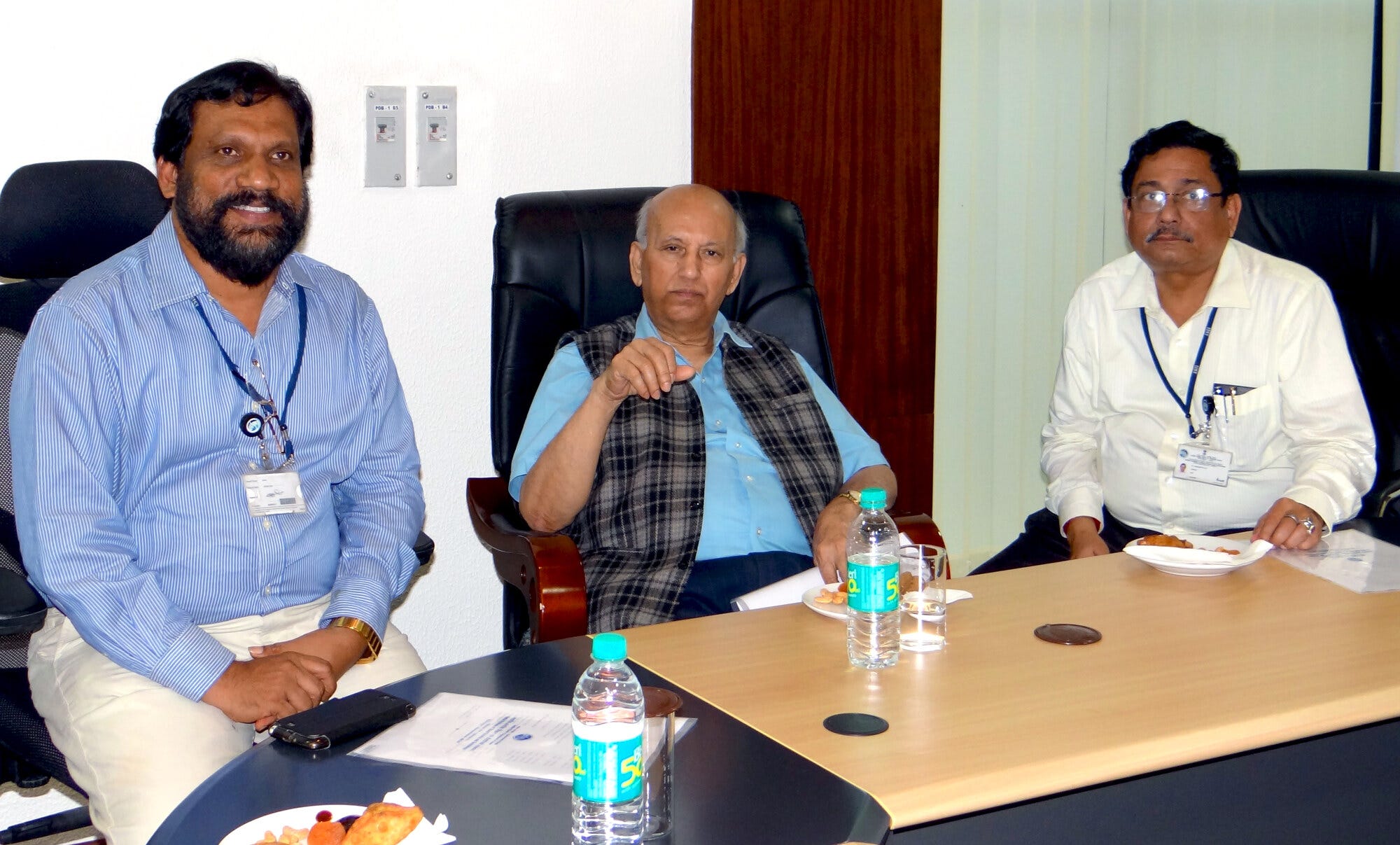
"That is what I call the ISRO culture. The interdisciplinary approach and the review mechanism. Everyone attending the review understands what is happening, and the review sets a timeline for the next review. Time-bound delivery. When a launch is declared, the scientists are dedicated one hundred percent. They forget family. Twenty-four by seven, from top to bottom of the hierarchy, they are working as a team. There is no ego clash. That is the success. I have personally experienced it."
The specific mechanism he admires — and has spent years importing into IIST — is that ISRO does not lock scientists into the discipline they were hired for.
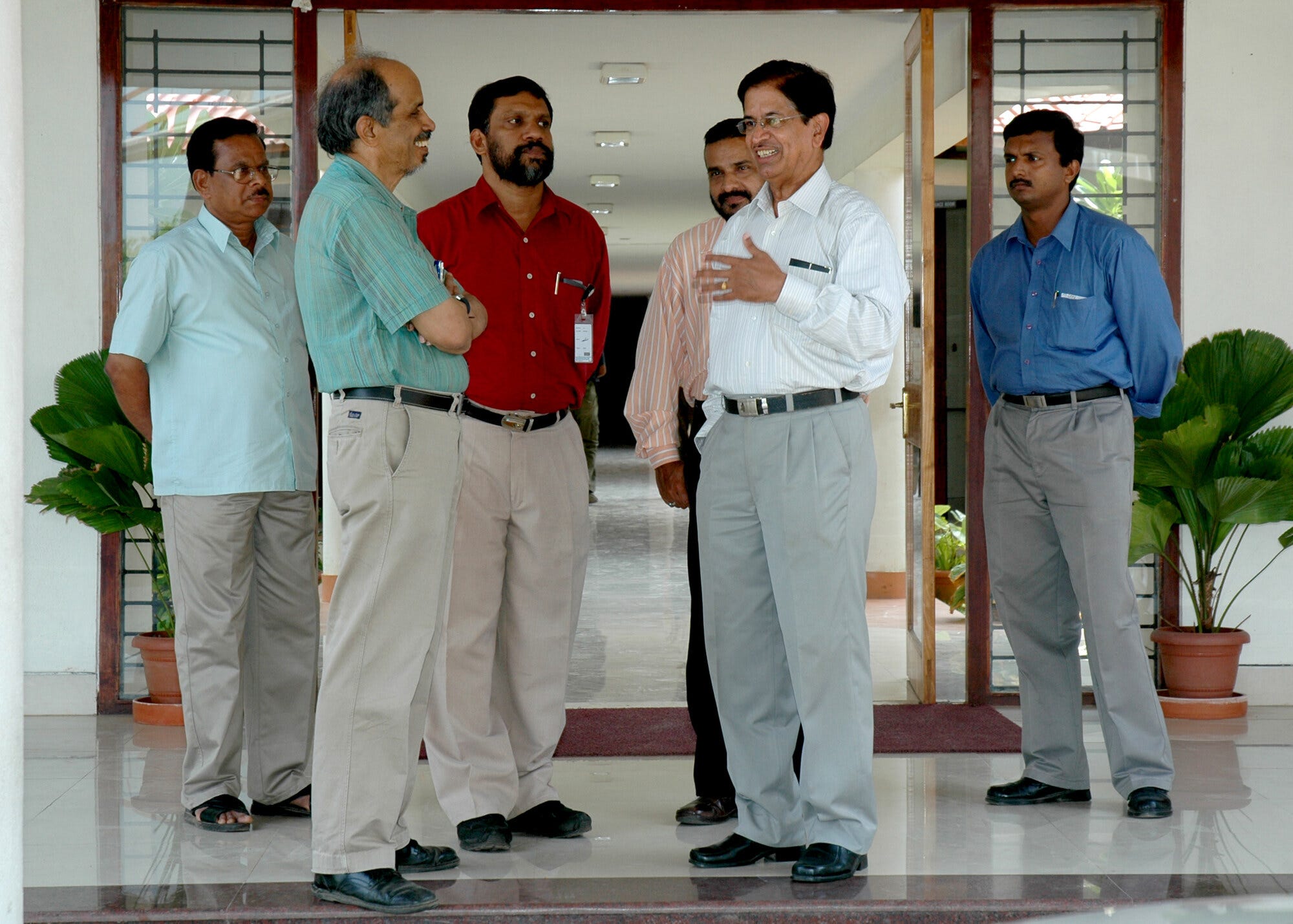
"A scientist may join as a chemical engineer. Over a period of time, he or she is getting expertise in structures, in propellants, even in avionics. And after some time, he or she may be heading another entity altogether. That is ISRO practicing the interdisciplinary approach from the beginning."
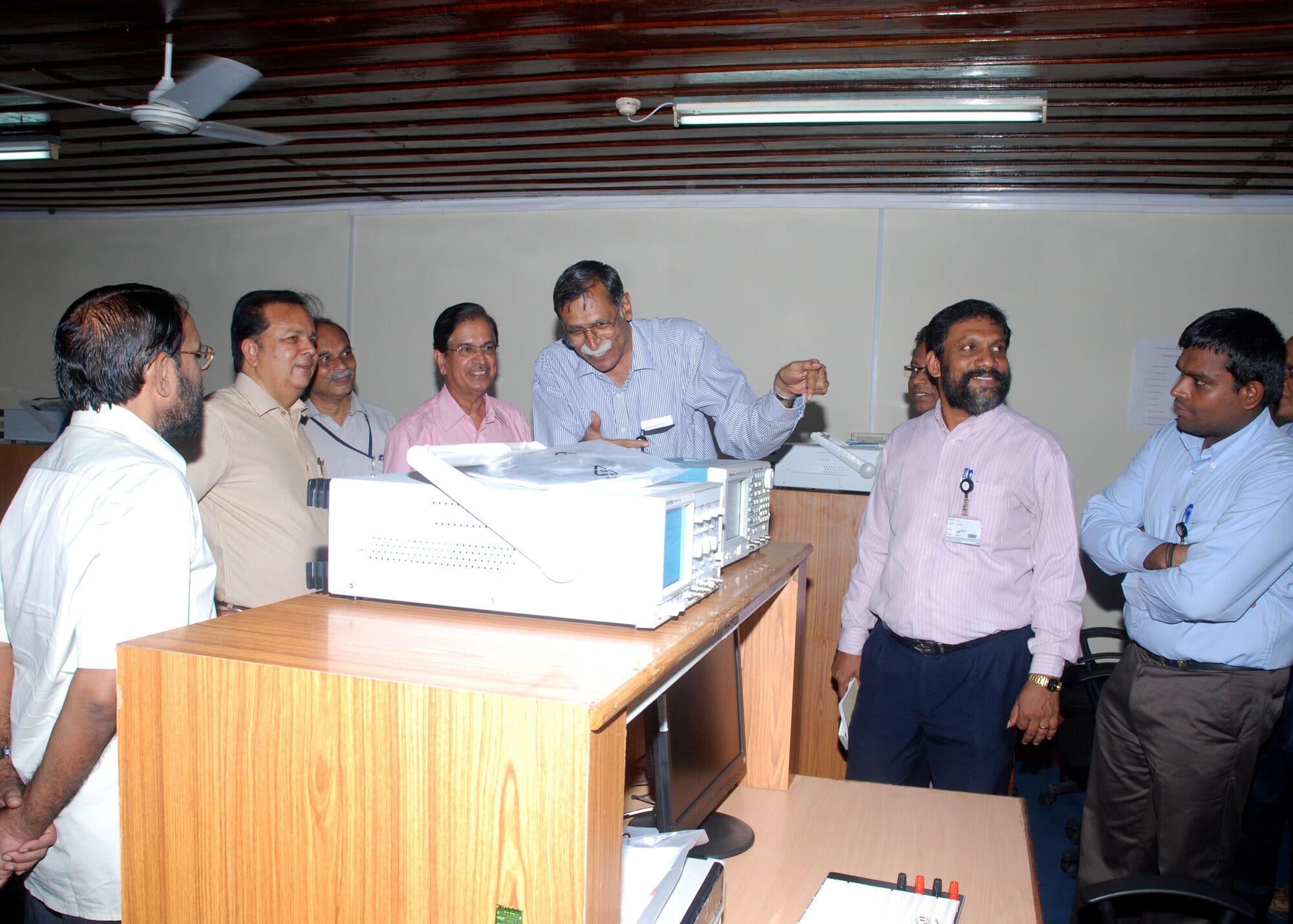
At IIST, the same open borders are built into the degree. Undergraduates carry nine credits of curricular and extracurricular work outside their home discipline, and can take minors across departments. Students spend day and night in the satellite laboratory building real components for real missions — cloud-tested, flight-bound, not classroom exercises.
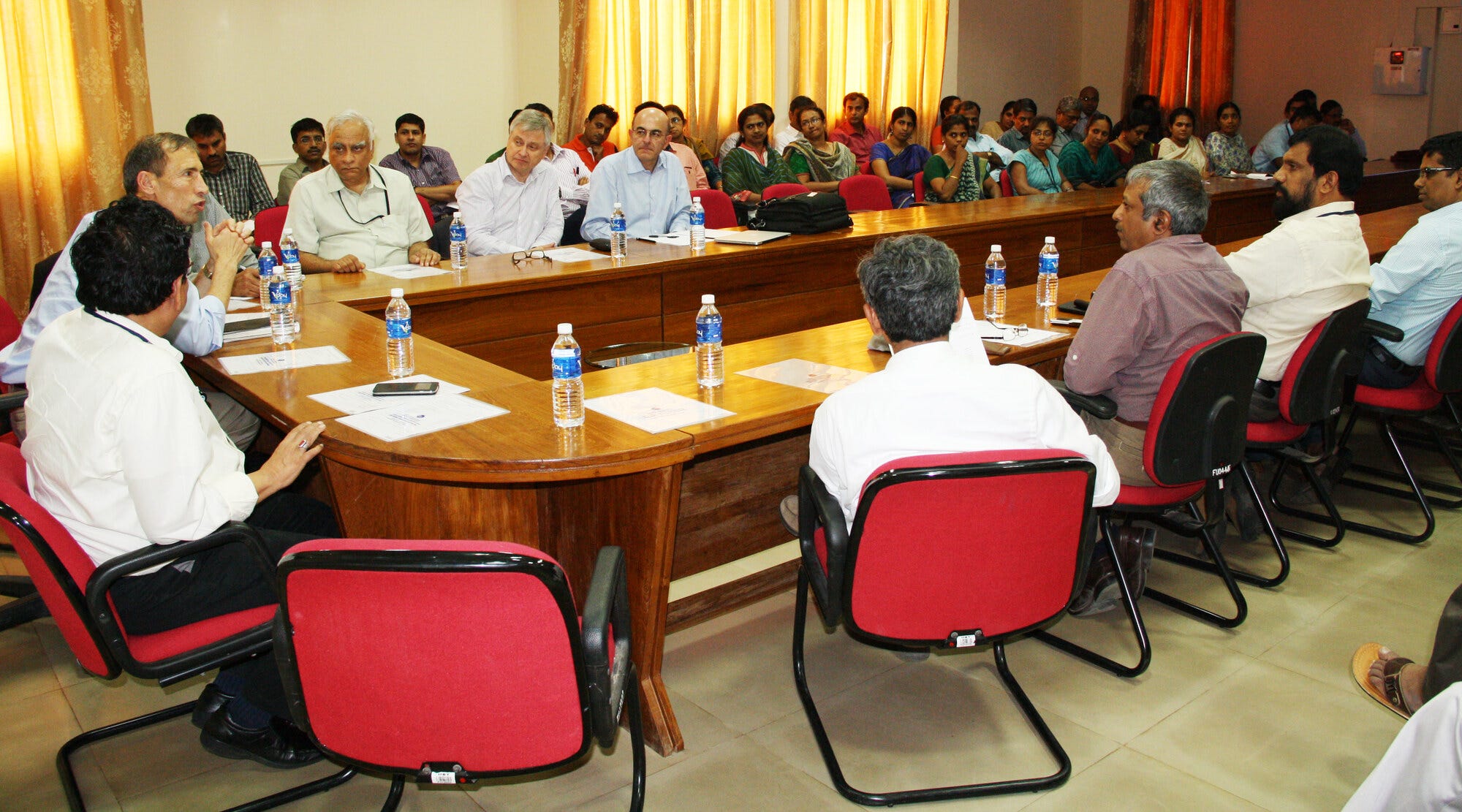
"This type of field learning process is very, very important."
He tells the story of one undergraduate — an aerospace engineer by training, a discipline whose graduates are expected to end up in structures, thermal or propulsion. The student drifted instead into IIST's remote sensing group, got his exposure there, and after graduating ended up at one of the country's leading private space startups.
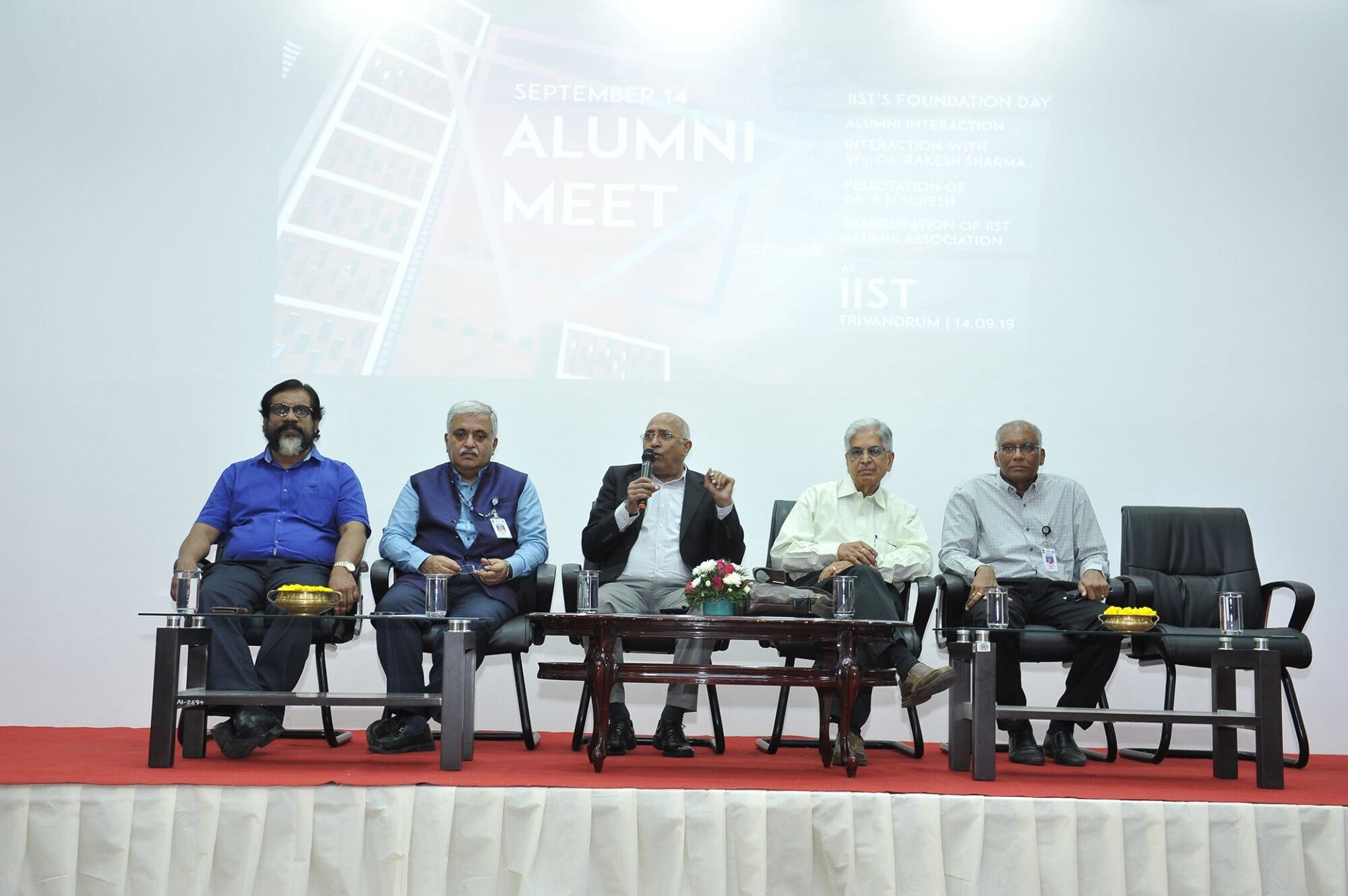
"We don't know where and how it is going to spark on your mind. We need to give exposure to all areas wherever possible. That is it."
The model produces hardware as well as careers. The Government of India, he notes, is now explicit that research innovation should be linked to industry, and IIST has a growing list of examples built with industrial and academic collaborators.
The example he cites: a costly instrument India had been importing — an atomic layer deposition system, which lays coatings a few atoms thick on parts like precision bearings — recently built in India through such a collaboration.
No problem, no innovation
Underneath the institutional argument sits a more personal theory of how engineers are actually formed. It is the same theory that made him grateful, not resentful, about hunting sisal on foot.
"The classroom teaching is to strengthen their theory. Theory should be appropriately practiced. When you are doing the practice, only problems will come. Those problems are the real driving force for all innovations. If there is no problem, there are no innovations."
Problems, for him, are the raw material. Theory turns into capability only by meeting them.
"The problem must be there. More important is how you are going to tackle the problem. That is where you need a system engineering concept — breaking down the problem, just as in finite element analysis. Breaking the problem into small pieces and building up. Once there is a problem, people don't know how to address it."
At IIST the students run a programme called Tomorrow's Engineers, built around exactly this: system engineering — breaking a problem too big to solve into pieces small enough to solve. That skill, he says, is the real gap in Indian engineering education.
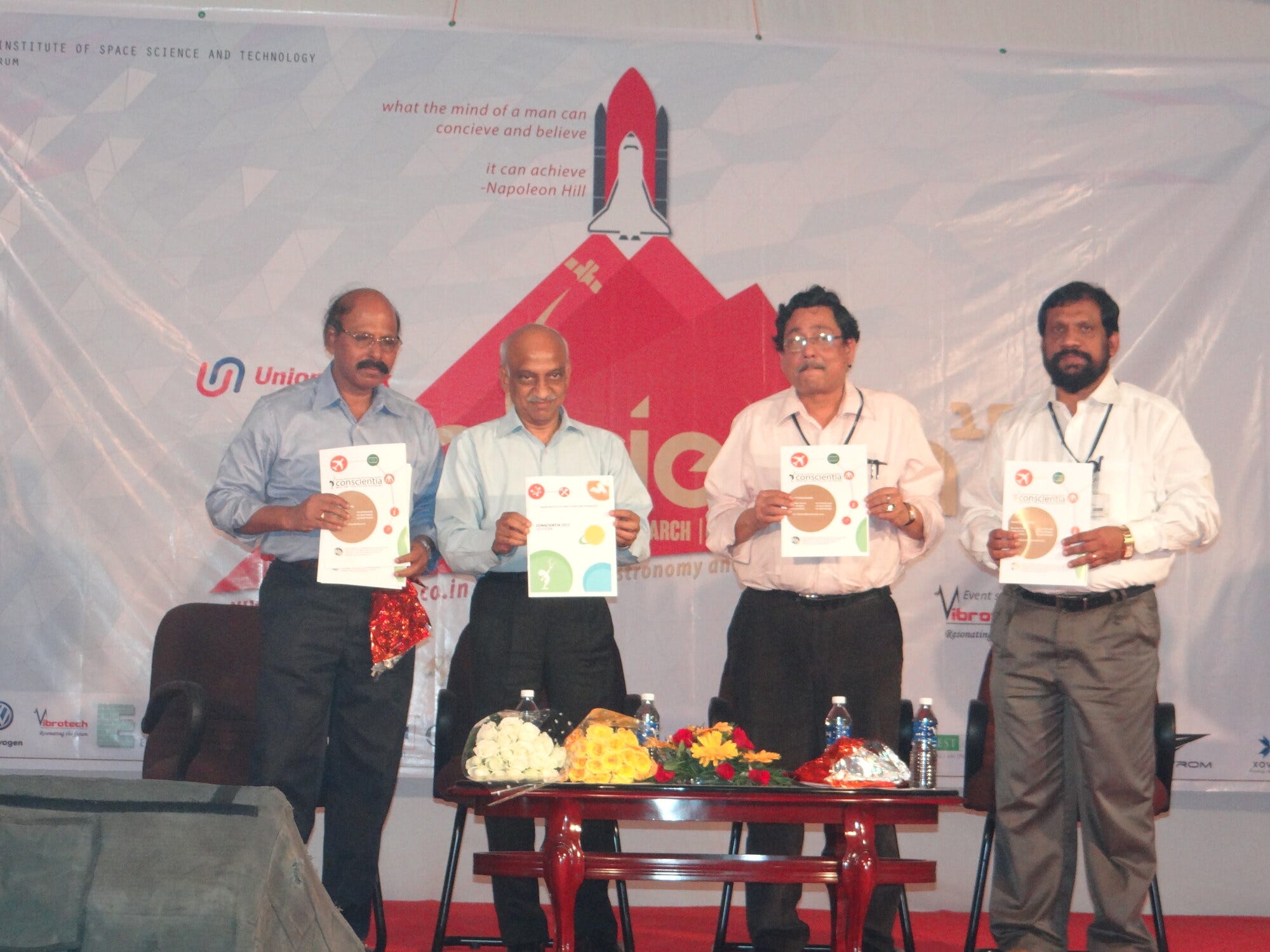
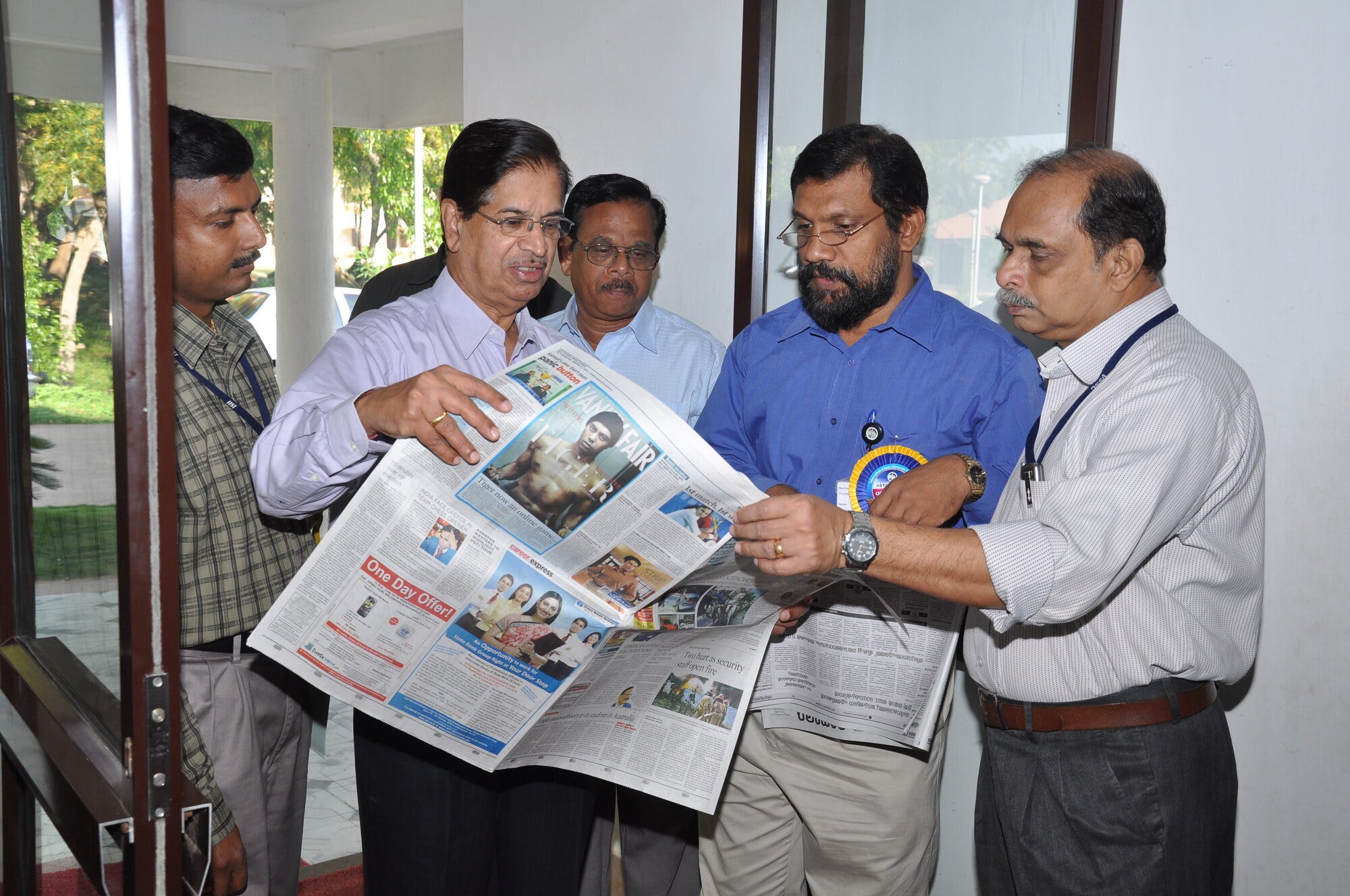
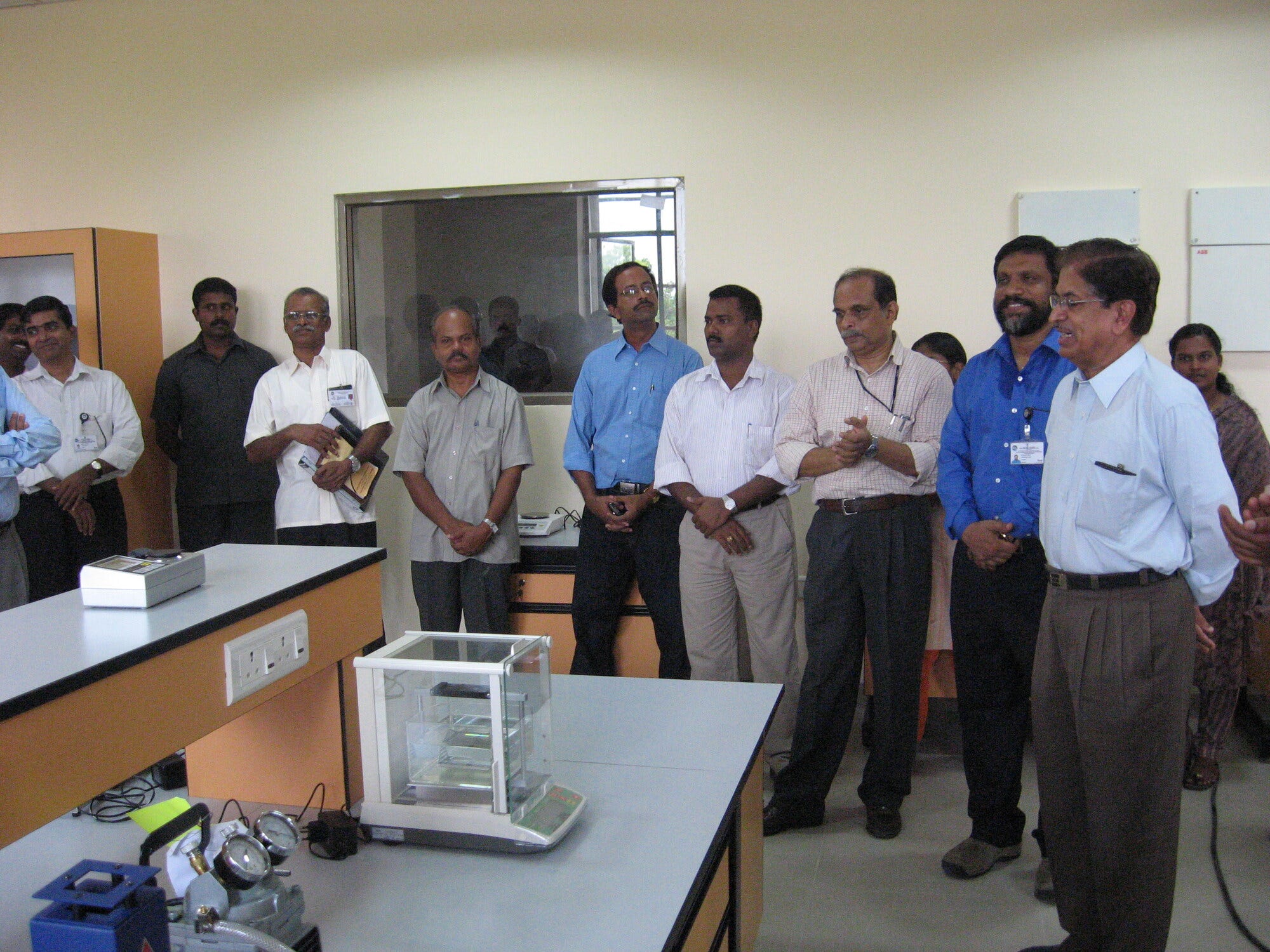
And when he wants a live example of the theory, he points at the other end of the video call.
"Gagan entered this industry. He may be facing a lot of problems. He is trying to solve those problems, and after solving them, new problems will come. These problems are the driving forces, and innovation will come."
Later in the call he returns to the same example and completes it.
"He is having the idea. He is implementing it. At the implementation and execution level, he is undergoing a lot of problems. He has to troubleshoot all these problems. But the experience he is getting is tremendous — we cannot imagine it. So we should have an ecosystem where the students, the industry, the academicians are sitting together, working together."
Future is composite
Ask him what the next fifty years of materials look like and he answers in one line.
"Future is composite."
The argument runs on two facts. The first is tailorability.
"The good thing is, I can tailor the product."
A metal gives you the properties it has. A composite gives you the properties you design — you choose the fibre, the matrix, the layup, the process, and you get a material tuned to the load case. The second fact is specific strength: a metallic structure is strong but heavy, and once you divide strength by weight, composites win almost everywhere it matters. Aircraft are moving toward all-composite airframes. Marine applications prefer composites because they do not corrode. Carbon fibre, Kevlar and new epoxies are remaking aerospace and automotive, and in the last few years household goods — bicycle frames, sports equipment, consumer products.
India's problem sits one step upstream: the country does not make the raw material.
"The challenge is that we don't have a good carbon fibre manufacturing unit in India. We are trying, even today."
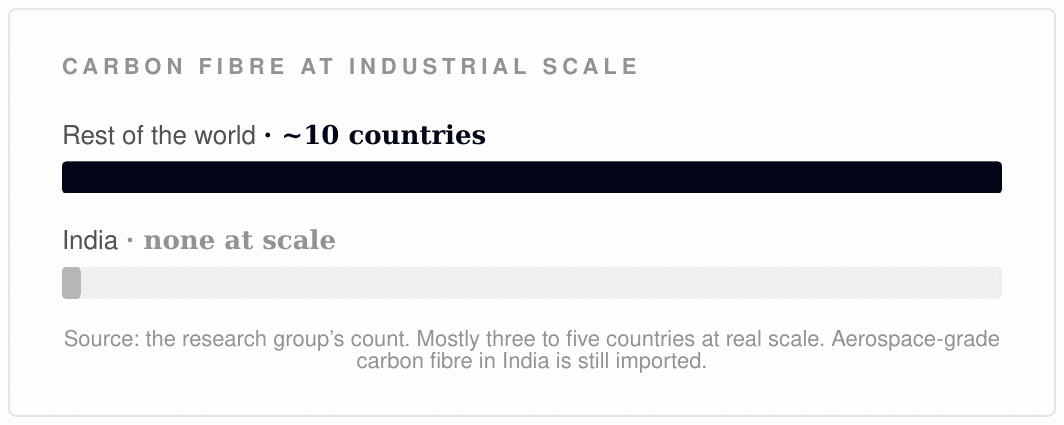
(Editor: A few Indian players run small carbon fibre lines, but aerospace-grade supply is almost entirely imported. By the research group’s count, perhaps ten countries manufacture carbon fibre, and three to five do most of it at industrial scale.)
His research group is working on one answer — low-cost, high-performance carbon fibres made from natural resources, as an alternative to the petroleum-derived precursors the industry standardised on. And he puts a number, flagged as a guess, on the scale of the dependency.
"I'm not exact, I don't know — but I imagine that almost sixty percent of the composite industry is import-dependent."
The exact figure matters less than the pattern. Indian composites manufacturing depends on imported fibres, imported resins and imported machinery. Cut any one of those links and production stops.
The second thing he wants Indian composites to do is get smarter. It is where his own group works.
"Smart composite materials. Lightweight, smart, self-healing."
A smart composite responds to an external stimulus — light, heat, an electric or magnetic field — by changing shape, stiffness or some other property. A self-healing composite repairs itself.
"Suppose I have a structure made of composite. A crack appears. Automatically, it heals. Otherwise the crack will slowly start propagating, and finally the system will fail."
His group has built several pieces of this. The work now runs from advanced multifunctional composites to bio-derived materials — a broad front, with one recurring theme.
The group took on one of the oldest trade-offs in the field. Epoxy is brittle. Add a conventional toughening agent and the strength and modulus fall. They wanted all three at once.
"I want to keep the strength and modulus, and at the same time improve the toughness. That was the challenge."
The group's route: take a carbon material — graphene oxide, say, or carbon nanotubes — and modify it by grafting. The resulting composites perform better across the board. The research did not stop there. It went deeper — into the role of materials and their interfaces in epoxy systems, into block copolymer modifications, and into several grafting strategies for toughening, with improvements of 200 to 300 percent. The same mechanisms are now being tested in bio-based epoxy systems, with sustainability as the central focus. Dr. Saritha and Dr. Deeraj led the design and execution of these projects.
"Excellent toughening. Up to 300% improvement in the toughness of epoxy."
The group also developed carbon fibres in the laboratory from commercially viable, reliable precursor sources — lightweight, flexible fibres that shield electronics from electromagnetic interference.
The current frontier is functional materials. Epoxy vitrimers: dynamic polymer networks that keep a conventional thermoset's strength, thermal stability and chemical resistance, but can be reprocessed, heal their own microcracks, and be recycled. Ultralight porous aerogels engineered for thermal insulation, energy storage and environmental clean-up. Metal–organic frameworks — crystalline materials with tunable pores and enormous internal surface areas. And biosensors, where the group holds patented innovations in sensing platforms for rapid, sensitive detection.
Across all of it runs one emphasis: recycling, sustainability, and next-generation materials that cut environmental cost without giving up performance.
Getting industry to pick such things up is the hard half. He does not blame the buyer; he describes the buyer's arithmetic. An established manufacturer has a supply chain, a customer base, margins that work. A new material arrives with a qualification timeline attached
"If you talk to an established manufacturer — a guy comes, says these are the opportunities — they say it will take ten years. They already have a supply chain and they have a market. Why should I? That mindset is there."
"Fortunately, that is happening slowly now. Some of the good companies are investing a lot of money in R&D. Earlier, R&D investment was only for the sake of tax saving or something like that."
His fix is the one he keeps returning to: put industry inside the campus, so the researcher sees the qualification timeline before the research direction is set — and so the incumbent meets the material before it is a threat.
But ask him whether the incumbents can simply block what is new, and he pushes back.
"It is also there. But it all depends. If I am really inspired, I am really motivated — whatever the hurdles, whatever they think, nobody can stop."
The startup problem
Which brings the conversation to the man half-hidden by sunlight at the other end of the call.
Gagan Agrawal was in IIST's second batch — his years at the institute began in 2008, one year after Kuruvilla Joseph's own. He is now the founder of Planet Material Labs, and he joins the interview from an office he describes, laughing, as completely out of space: every room blocked with equipment, ten days from moving into its own factory.
Kuruvilla Joseph brings him up, repeatedly and by name, as the exception to everything he has just described.
"People are not taking that risk. That's why you appreciate Gagan. Because he took the risk. It is challenging, and he took it as a challenge — to demonstrate the opportunity."
"People like that — a B.Tech from IIST, excellent coaching from our institute, the kind of position that is a dream for many of the youth in India. But his passion was something different. He wanted to start a new company with his own innovation. That is what is needed. That was missing in our country. Fortunately, for the last five to ten years, because of new government bodies, a lot of people are coming into that."
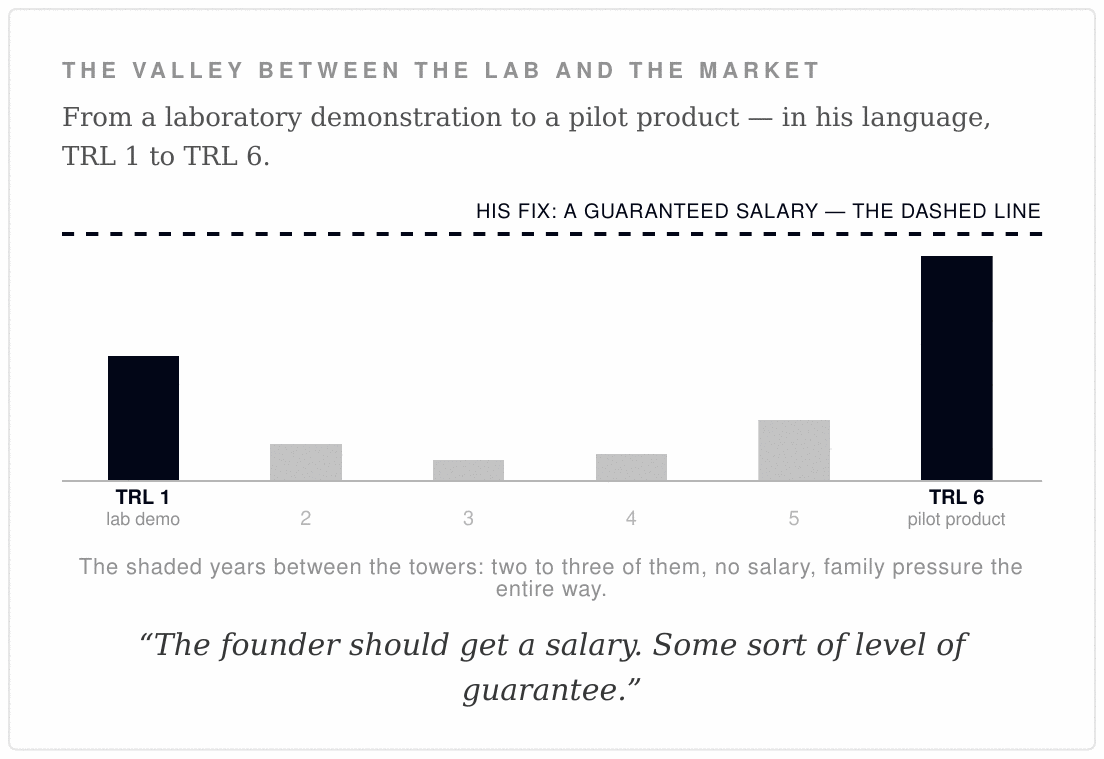
Then he lays out the founder's actual problem. Taking a technology from a laboratory demonstration to a pilot product — in his language, from TRL 1 to TRL 6 — takes two to three years of focused work, and at least two. During those years the founder earns nothing, while the family and society around him push in exactly one direction.
"Meanwhile, your family and society are not supporting you, because you should go for a job — this is a very, very risky business, what about your future. We are human beings. Naturally, it will be in your inner mind."
The fix, as he sees it, is financial.
"There should be fantastic, continuous financial support for those who are involved in startups. The founder should get a salary. Some sort of level of guarantee. I have discussed this with many startups. Maturing an industry is not an easy thing. Competition, financial management — a lot of things we have to support. That is very, very important."
Several countries already run versions of it. The US has SBIR and STTR grants. Germany has EXIST. Israel built the Yozma model of state capital matched to venture funds.
India has its own schemes — BIRAC, NIDHI, the Startup India Seed Fund — but the coverage is thin, and it is thinnest exactly where he works: deep-tech hardware, where the runway to a first product is measured in years, not quarters.
His second proposal is the consortium. Not every materials startup can fund its own pilot line, and in his view they should not have to.
"We cannot compare ourselves with Reliance or the Tatas or Adani. There are small players. Their investment level is very, very limited. We can have a consortium of industries in similar or related areas. Pool the resources — infrastructure and money. By that, the competition between these small industries can also be reduced."
I told him — warning him he might laugh — that what he was describing is what venture capital is supposed to do: pool risk, pool patience, pool commercial knowledge around a thesis. He did not disagree. His answer was that a founder mobilising money stays locked on a single vertical, while the transition now arriving — he calls it Industry 5.0 — will not respect verticals at all.
"We should equip our industries, especially small-scale industries and startups, to address that. For that vision we need a collective, cooperative effort, where all streams of people are coming together. Because everything current is going to be outdated in another couple of years. Not fifty years."
A materials bank
The other thing he is convinced India needs, and does not have, is a strategic reserve of critical materials.
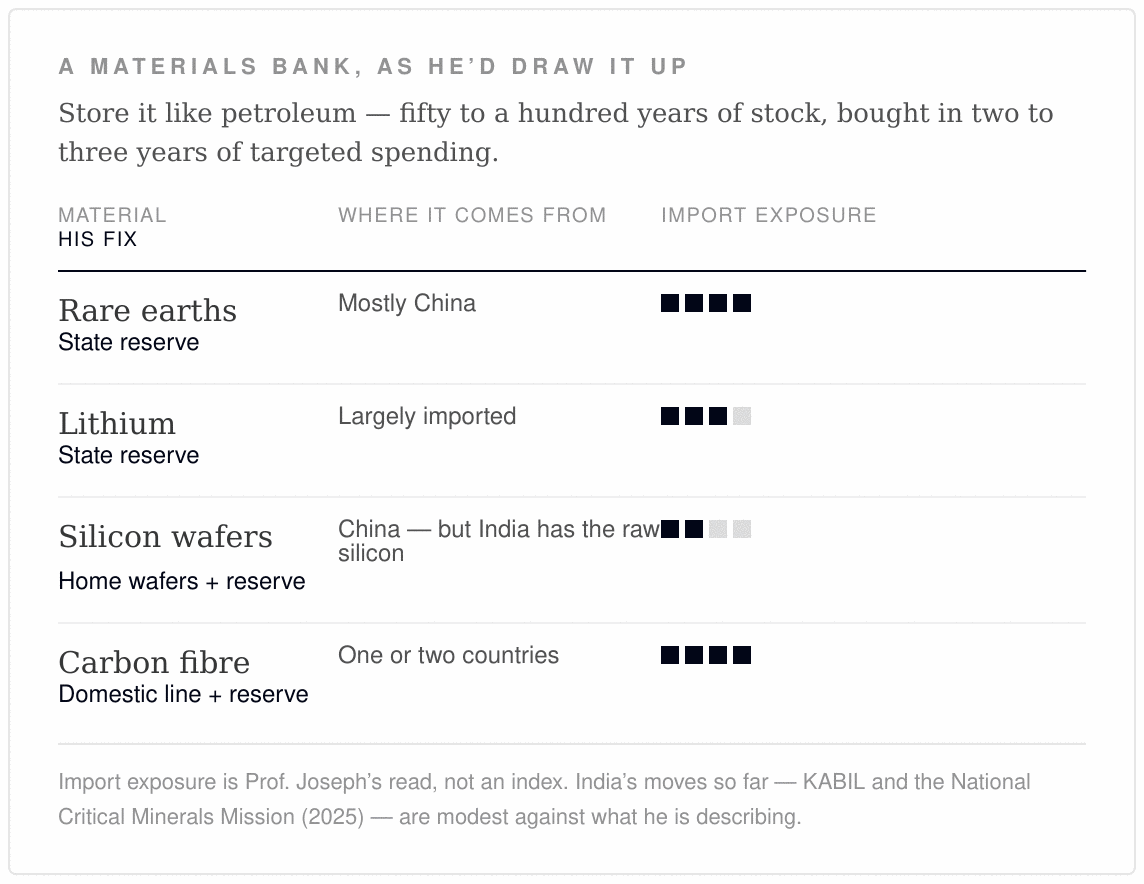
"We are facing a materials block. We need to have a materials bank. Just like petroleum — we are storing petroleum. We should develop a strategic deposit of materials, under the control of the government. Then only will the industry grow."
He lists the gaps. Rare earths. Lithium. Silicon — India has good silicon deposits, he notes, yet most wafers still come from China. Carbon fibre is worse: dependent on one or two countries.
"We don't have all of it. We should collect and keep it as a future resource."
"Somebody may think — no, no, we are not going to supply. Then we will be in trouble."
The war currently running through global logistics has already given India a preview; even medicine supplies, he points out, have been affected. What he is prescribing is an infrastructure programme.
"When you are becoming a superpower, you should have your own deposit of all the raw materials. In a targeted way we have to spend money — in another two, three years' time, you should have enough raw materials for the next fifty years, hundred years of work."
How? India, he argues, has one under-used asset here: its diplomacy.
"India has very good diplomatic relations with many countries. We have to do collaborative research and spend money to get these materials. And we should have a huge storage of that."
The framing sounds unfashionable — strategic stockpiling reads as a 1970s planning commission idea — but the substance has resurfaced in critical minerals policy across the United States, Japan and the European Union, all of which are building state-backed reserves of the materials he lists.
India has begun similar efforts through KABIL, the joint venture for critical mineral acquisition abroad, and the National Critical Minerals Mission announced in 2025. The scale is modest relative to what he is describing.
"Without materials we cannot do anything, even if we have the concept. Everything will depend on another country."
AI and the composite
The last strand of his view concerns how the research itself is going to change.
"Earlier, I had to fix the fibre content, the matrix content, make the composite, test it, do a theoretical simulation, and finally fix it. Now, because of AI and machine learning, they can predict everything. They can predict the shape. They can predict the properties. They can even select the best materials available within these properties."
He describes designing a composite the way an architect briefs a building. His other word for it is a recipe.
"Just like an architect: I want to produce a product, and my condition is that this material should have this much strength, the modulus should be this, the toughness should be this, the elongation should be this, the thermal coefficient, the environmental stability — I am listing fifteen, twenty criteria. I have a database. The system will enable me to select the best combinations, and if I am going to have this, what would be the processing — and they can also predict what problems you are going to face, and how to solve them."
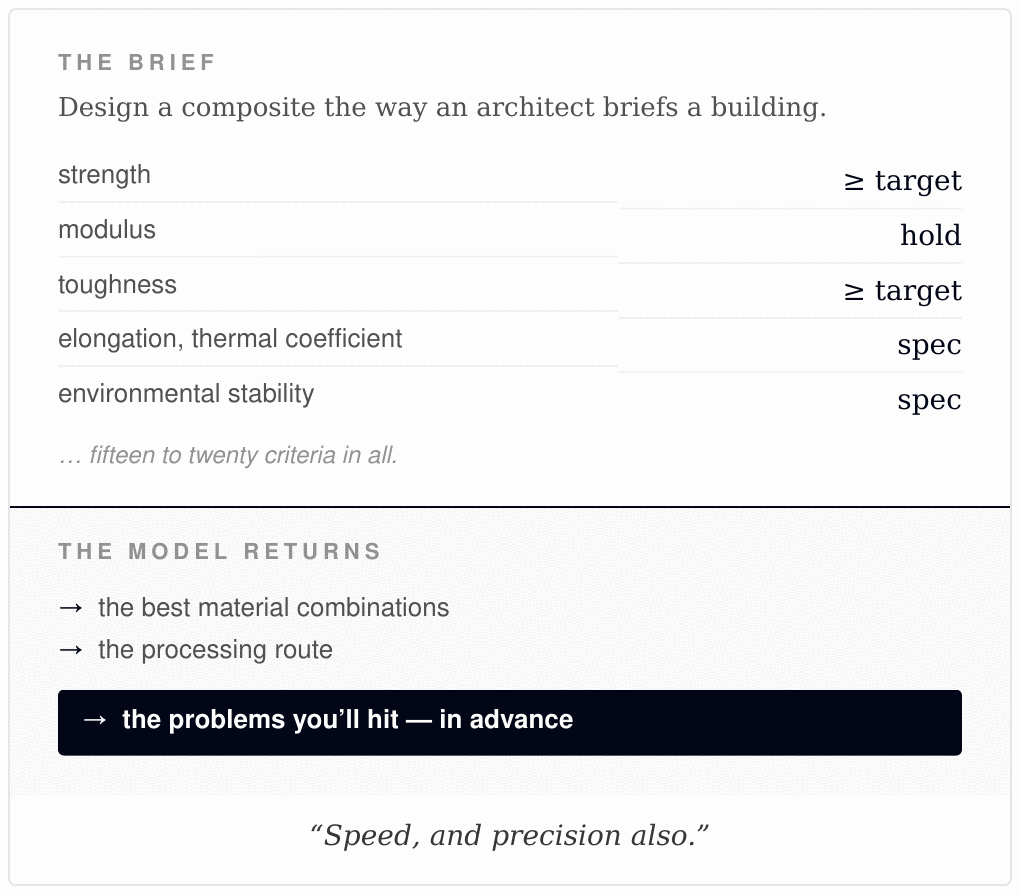
The part he values most is the last item: the problems, predicted before the first sample exists. For a man whose whole method is built on problems, an engine that forecasts them is a new kind of instrument.
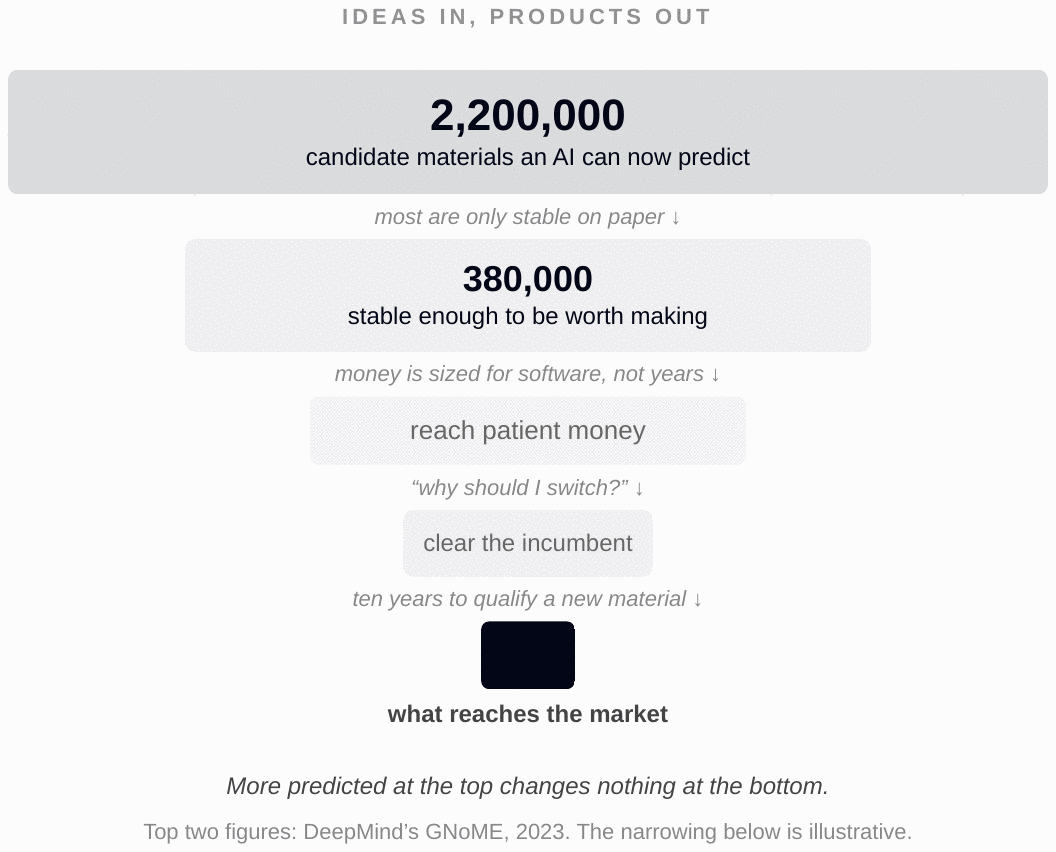
Companies like Citrine Informatics, Uncountable and MaterialsZone have been building toward this for a decade. Google DeepMind's GNoME model, published in late 2023, predicted 2.2 million new inorganic crystal structures — about 380,000 of them stable enough to be candidates for synthesis, a haul DeepMind likened to nearly 800 years of materials discovery. Composite design — fibre, matrix, filler, process, each choice multiplying the next — fits the same methods.
"Speed, and precision also. A total revolution in the coming years. In the industry, everywhere, it is going to go this way."
Once the design problem is reduced to prediction, the bottleneck moves back to where he started: identifying the right problem, and building the path from lab to market. AI does not solve that part. A country that cannot commercialise its ideas only gets faster at producing ideas it cannot commercialise.
Metamaterials
Materials keep replacing one another, and aerospace shows the pattern most clearly.
"Aerospace material started with wood. Aluminium alloy is there — but for the last several years, carbon-carbon composite has been the biggest market in the aerospace industry. Even the space industry."
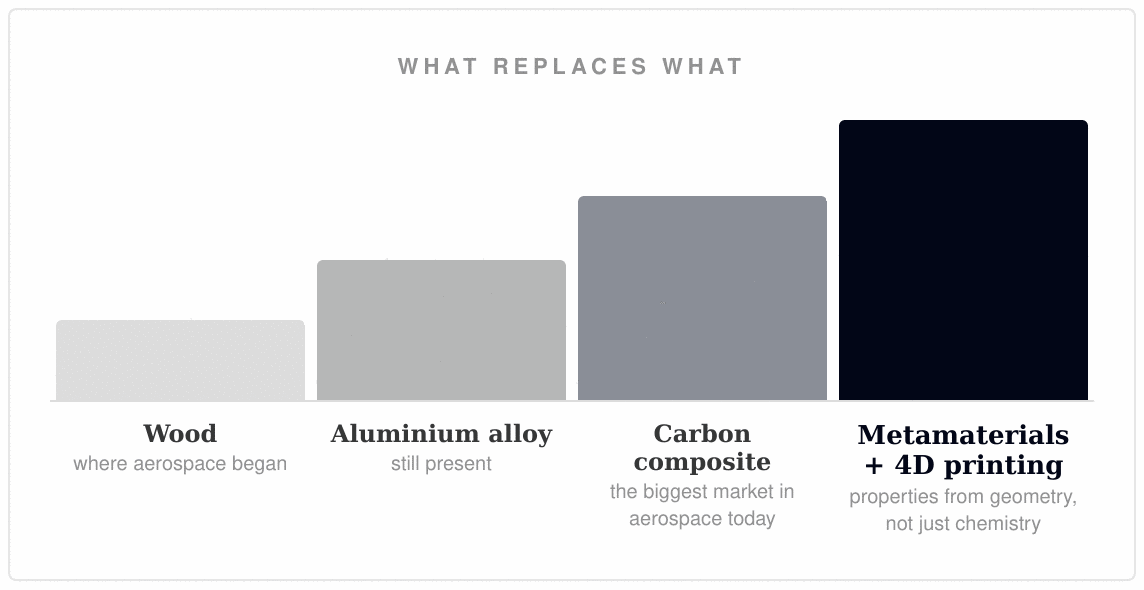
So the question is what displaces composites. Ask him, and he does not hesitate.
"Metamaterials. The next level is coming."
A metamaterial gets its properties from its geometric structure, not just its chemistry.
"I can simulate the properties by changing the directions and the shape."
Combine that with 4D printing — printing objects whose shape changes under heat, electric or magnetic stimulus — and a material stops being a part and starts being the machine. He gives two examples, one small and one large.
The small one is a gripper.
"I can think of a robotic arm made up of a composite and polymer. Given a magnetic or electric stimulus, it can go and pick something up. For that property, the chemistry should be strong enough."
No motor, no gears. The grip is a property of the material itself. The large one is the aircraft wing.
"Imagine the flight wings. There are flaps, and for the different controls, actuators and motors. Suppose I have a simple polymer composite sheet that can do all this by stimulus response. I can reduce the weight, and the signal."
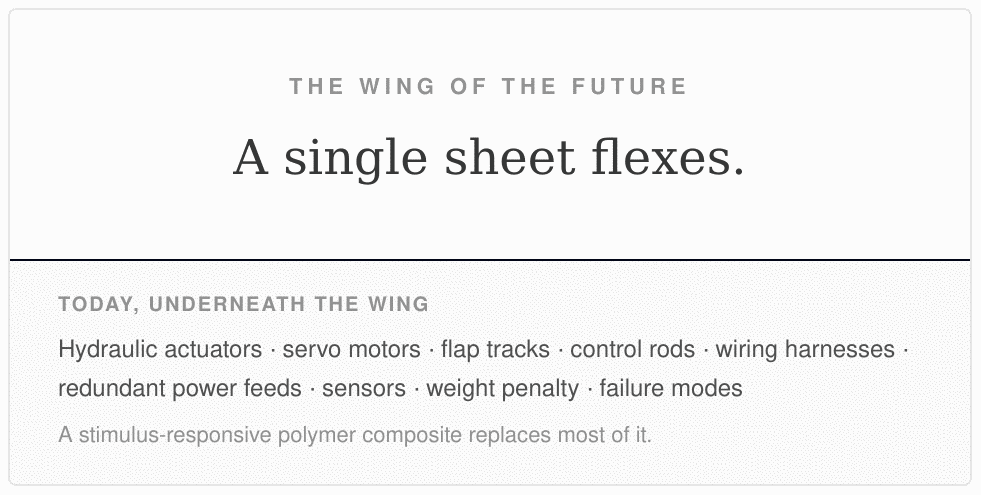
He holds up his hand and flexes his fingers — a wing flap made of a single responsive sheet, no hinge, no motor, folding because the material has been designed to. Less weight and less signal complexity. When I finished the thought for him — and fuel consumption falling with them — he agreed.
At the end of the conversation, he and Dr. Deeraj turn openly speculative.
"I believe that one day, humans will be printed."
The thought experiment behind it: a document can now be transmitted anywhere and reproduced exactly. If 3D printing keeps descending toward atomic scale, then in principle the specification of a physical object — eventually, a living one — could be transmitted and rebuilt elsewhere. Another planet, even.
He is half-serious. He laughs as he says it. But it is also a tell, because the underlying claim is one he means completely.
"The confinement of barriers between chemistry, mathematics, economics, social science, mechanical, electronics — that is over. For any development, we need a cross-disciplinary, multi-disciplinary approach."
And the list is not rhetorical. He puts the soft disciplines inside the design loop, not around it.
"When you are making a product, the social impact of the product, the economic aspect of the product, is very important. We are talking about sustainability — what do you mean by sustainability? The social science is very important. The economics is very, very important. When you are designing a product, all of this should come."
The philosophy
The thing Kuruvilla Joseph keeps coming back to is ownership.
He has worked in Brazil. He has worked in Sweden. He has worked at St. Berchmans, at Nirmithi, at IIST. In each place, he says, he did the same thing.
"You don't worry about where you are. You may be in a small industry or a small institute. But try to dedicate yourself to that industry, for the growth of that industry. Consider it your own. It is your own industry. It is your own institute. I did that. I'm doing that."
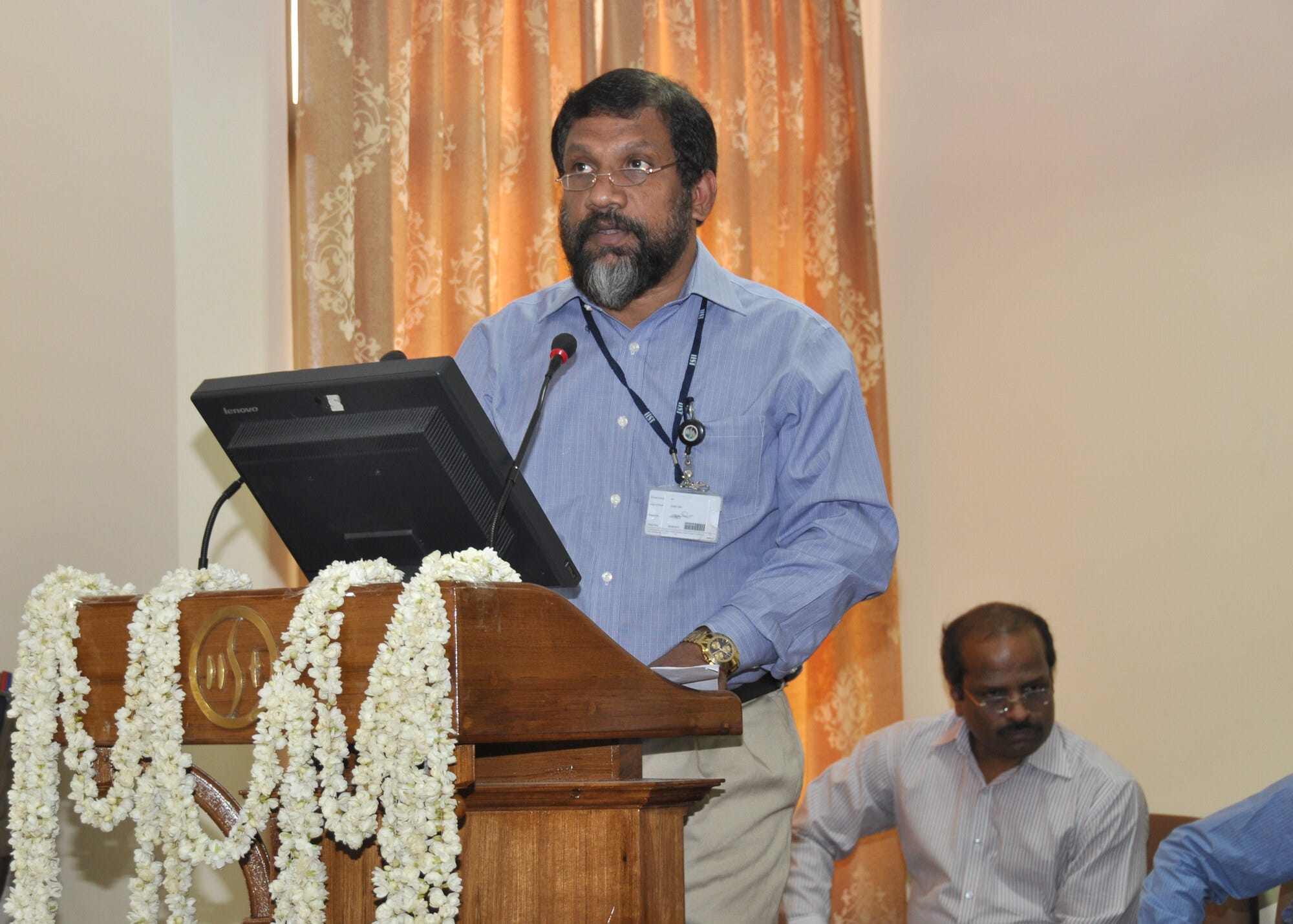
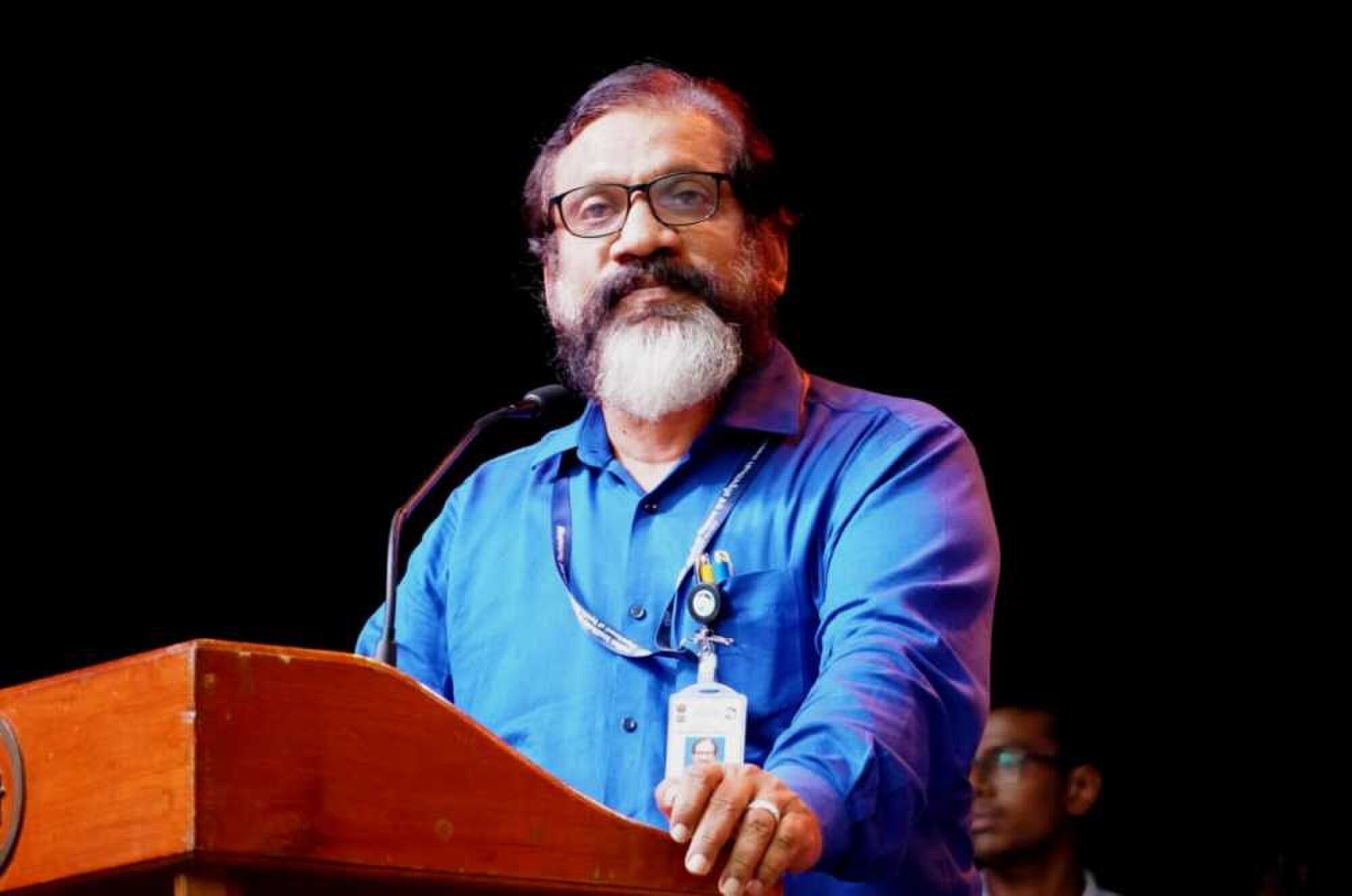
He says my institute often, and means it as a working principle, with a correction he makes himself: my institute means our institute. The word is for belonging, and should not be taken the other way.
"Each one of us should have the feeling that it's my home. My institute. If you have that concept, new ideas will come. You can discuss with others and try to implement them. That is the driving force."
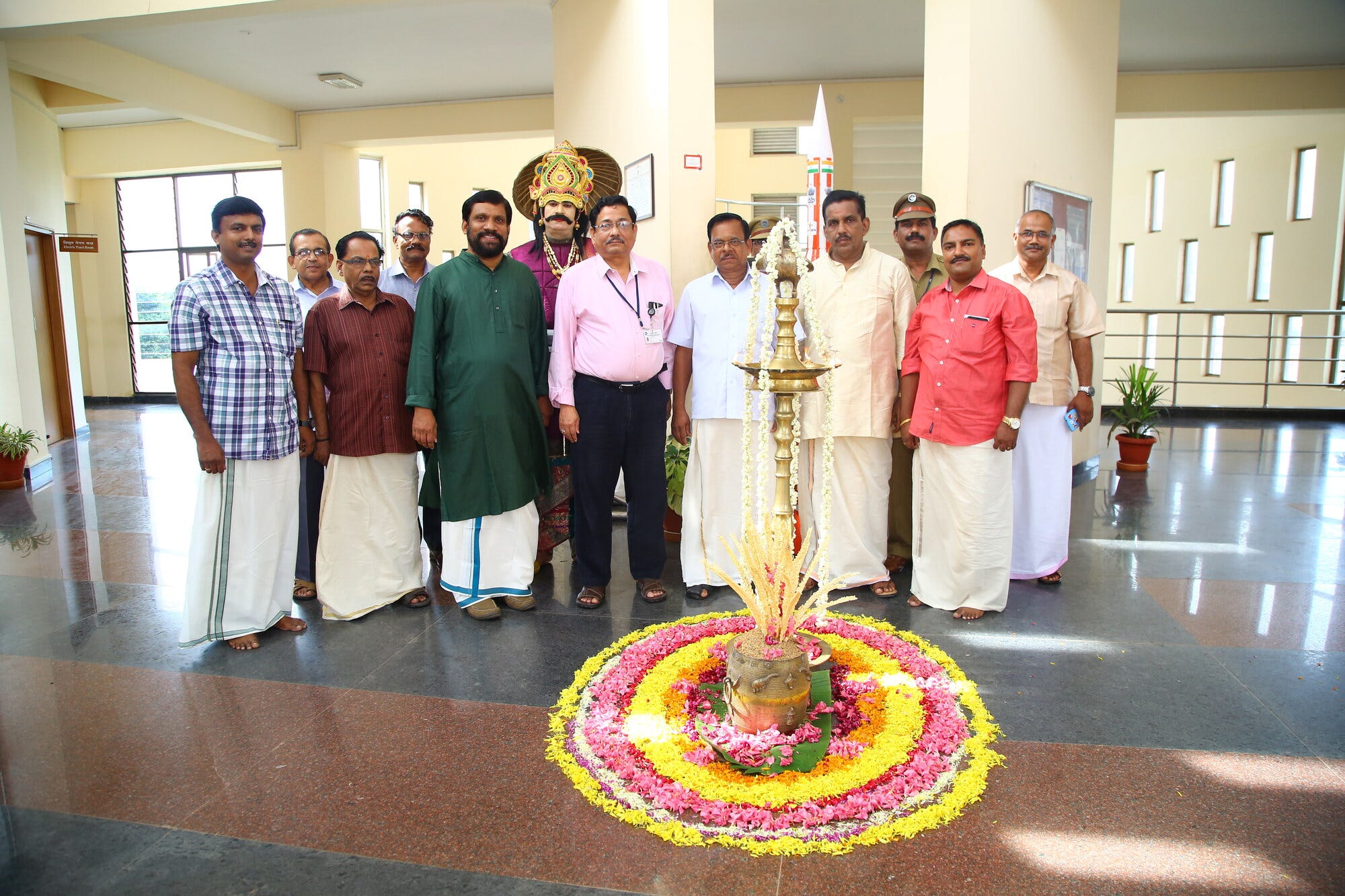
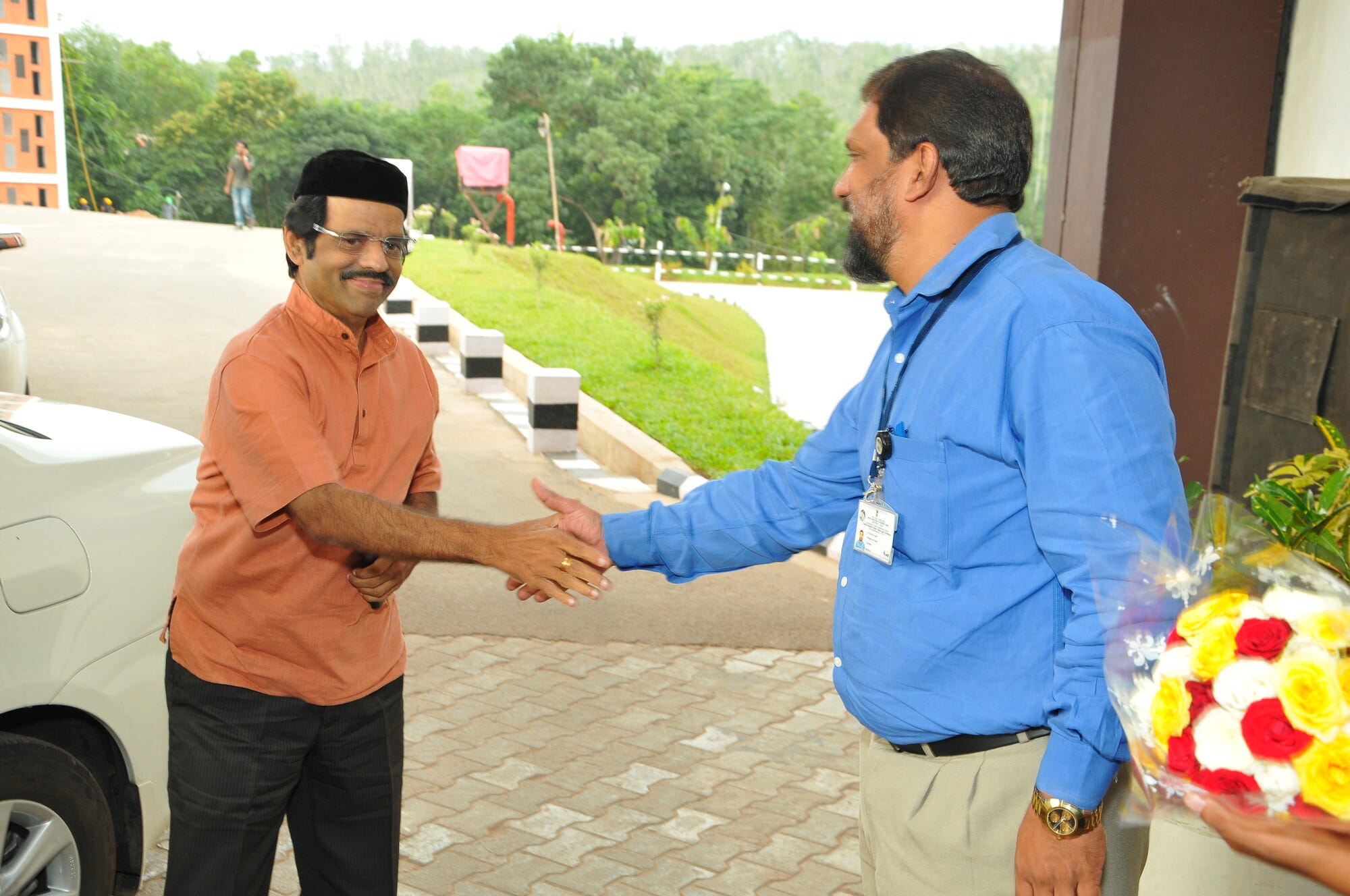
Partway through this, I told him he was reminding me of a book — Zen and the Art of Motorcycle Maintenance, Robert Pirsig's book about a single idea, quality: that how you do anything — down to tightening a chain on your own motorcycle — is part of who you are.
"Yes. That's why one should be passionate. Always, I am considering it that way. I was in many institutes — I told you, in Brazil, in Sweden, at St. Berchmans College. But here, I dedicated a hundred percent, even today. Because it's my institute."
There is no short answer to how you build that culture at scale, and he does not pretend to have one. But he has seen what it looks like when it works — at ISRO, where reviews land on deadline and chemists end up running avionics divisions. And he has seen what it looks like when it does not — in the seventy percent, in the paper-counting, in the certificate lying in his own drawer.
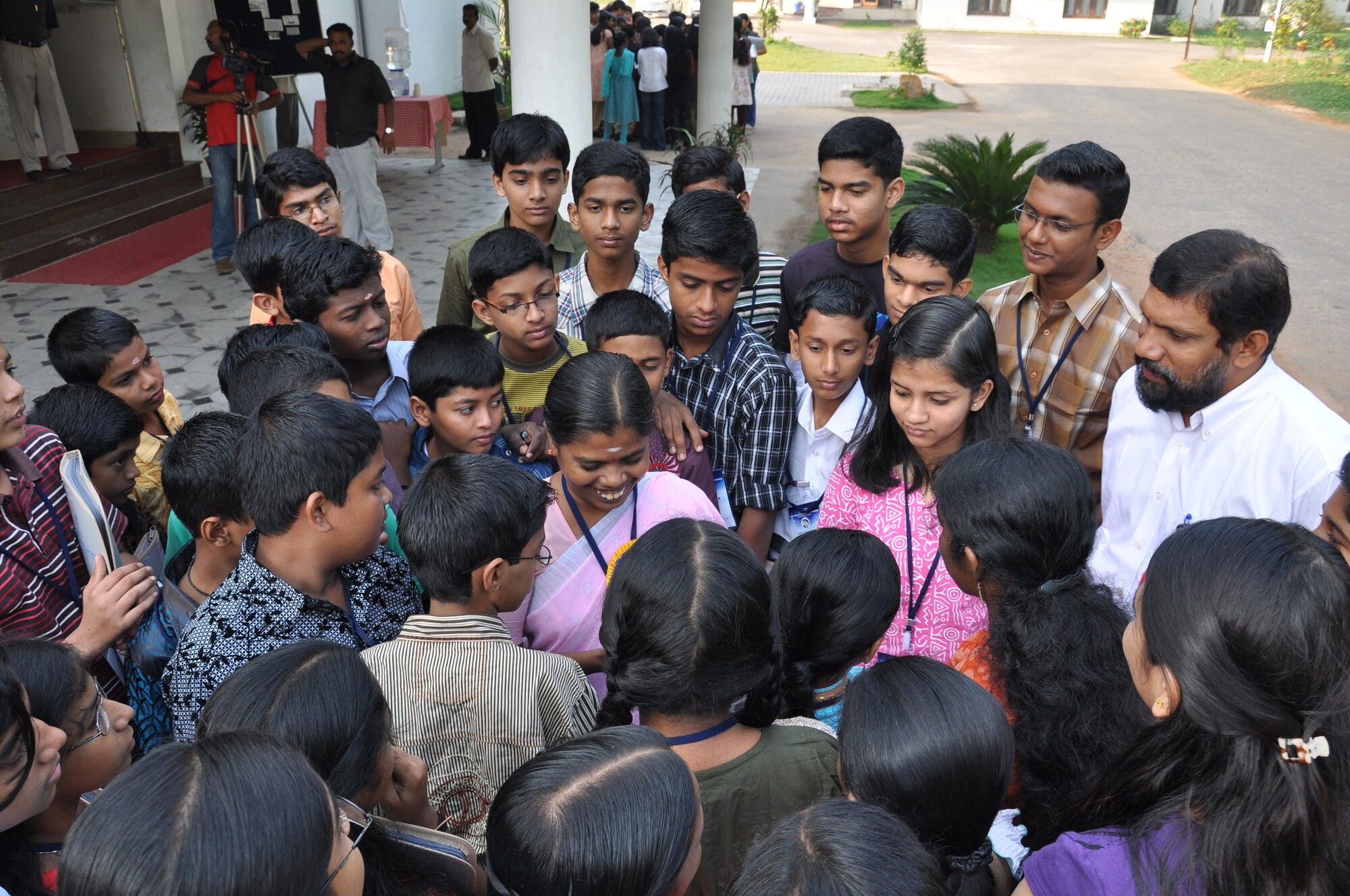
He is still running his group. He is still refusing to give students their problems. He is still trying to spark the next mind — his word for what exposure is supposed to do.
At the end of the call, he returns to the line that has organised his forty years.
"Future is composite. Even today, it is composite."
Safe harbor
This article reflects the interviewee’s views, which are his own and do not necessarily represent the positions of IIST, ISRO, the Department of Space, or any other institution mentioned. Some technical claims — including his estimate of India’s composites import dependency at roughly sixty percent, the research group’s count of carbon-fibre-producing countries, and the account of the indigenously developed atomic layer deposition system — are his figures and recollections, flagged as such in the text. Readers making investment, research, or policy decisions on the basis of this material should verify independently.
Methodology note
This story is based on an extensive interview with Prof. Kuruvilla Joseph, Pro-Vice Chancellor, Registrar and Dean, and Professor of Chemistry at the Indian Institute of Space Science and Technology (IIST), Thiruvananthapuram. Dr. B.D.S. Deeraj, his former PhD student, and Gagan Agrawal, founder of Planet Material Labs and an IIST alumnus, were also present on the call and contributed context. Quotes have been edited for grammar and clarity from a rough machine transcription of the call; the speaker’s voice and meaning have been preserved throughout. This is NOT a paid article.
